




-
 Apr 20, 2026
-
 Techno Deviser
-
 16 min read
- What is a 6 Month Industrial Training?
- Why 6 Months Is an Ideal Training Duration
- Who Should Join This Training?
- Training Options at Techno Deviser
- Skills You Gain From Each Training Program
- Why Practical Training Matters More Than Theory Alone
- How Industrial Training Improves Employability
- What Makes Techno Deviser Different
- Suggested Learning Path for Students
- Mini Case Study Examples
- How to Choose the Right Training Stream
- Career Opportunities After 6 Months of Industrial Training
- Why Students Prefer Job-Oriented Industrial Training
- FAQs
- Final Thoughts
Choosing the right training program can significantly shape the direction of your career. For students, fresh graduates, and beginners who want to enter the tech industry with confidence, a 6-month industrial training program is one of the most practical ways to build skills, gain project exposure, and become job-ready.
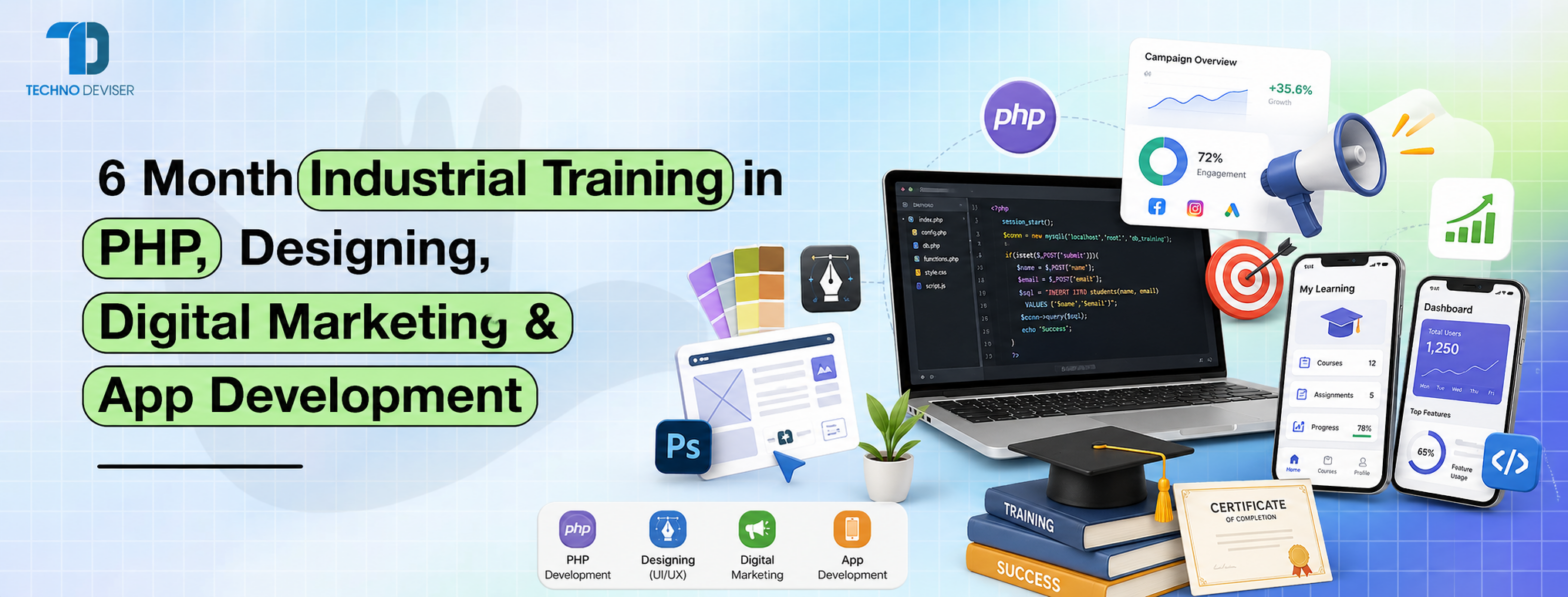
Moreover, at Techno Deviser, the 6-month industrial training program is carefully designed to help learners move beyond theory and step into real-world work environments. Whether your interest lies in PHP development, designing, digital marketing, or app development, the right training can help you build a strong portfolio, understand industry tools, and prepare for interviews with much greater confidence.
Furthermore, this approach becomes even more relevant when you consider current job market trends. The World Economic Forum’s Future of Jobs Report 2025 highlights that technology-related skills are among the fastest-growing globally. In fact, the report is based on insights from more than 1,000 employers representing over 14 million workers worldwide.
At the same time, the U.S. Bureau of Labour Statistics projects strong growth in software development, web development, digital design, and market research roles between 2024 and 2034. Therefore, developing practical and technical skills early can significantly improve your career prospects
Featured Snippet Answer
A 6-month industrial training program helps students and beginners develop practical, job-ready skills through live projects, mentor guidance, tool-based learning, and portfolio development. As a result, popular training options such as PHP, designing, digital marketing, and app development provide clear pathways into real industry roles.
What is a 6 Month Industrial Training?
A 6-month industrial training program is a structured and practical learning experience that gives students exposure to the tools, workflows, and project environments used in real companies. Unlike classroom-only learning, industrial training focuses on application rather than just explanation.
In simple terms, it bridges the gap between what you study in college and what companies actually expect from candidates. As a result, it also helps you demonstrate the right skills during interviews and internships.
Moreover, a strong industrial training program typically includes multiple components that support real-world readiness. For instance, it often covers:
- Concept building
- Practical assignments
- Live or simulated projects
- Expert mentorship
- Portfolio development
- Interview preparation
- Certification or completion proof
Consequently, this kind of hands-on preparation becomes highly valuable. In today’s competitive market, digital fluency and adaptable technical skills are increasingly important.
In fact, global trends support this shift. As Saadia Zahidi of the World Economic Forum noted, “the landscape of work continues to evolve at a rapid pace.” Therefore, gaining practical experience early can significantly improve career opportunities.
Why 6 Months Is an Ideal Training Duration
Many students ask whether 6 months is too long or too short. In reality, it is often the sweet spot.
A 6-month duration is typically long enough to build strong, practical skills. During this time, you can:
- Understand the fundamentals clearly
- Practice regularly and improve consistency
- Build multiple real-world projects
- Correct mistakes with proper mentor guidance
- Strengthen your problem-solving ability
- Prepare effectively for real interview questions
As a result, this structured learning period helps you gain both confidence and job-ready skills.
Why not just learn from random tutorials?
Free tutorials can be useful, but they often create fragmented learning. Learners jump between videos, skip foundations, and rarely complete full projects. Industrial training offers a clearer path:
- structured curriculum
- progressive modules
- real deadlines
- feedback loops
- accountability
- career direction
That structure is what turns knowledge into an employable skill.
Who Should Join This Training?
A 6-month industrial training course is a strong fit for:
- BCA, MCA, B.Tech, M.Tech, B.Sc IT, and diploma students
- fresh graduates seeking job-ready skills
- beginners switching into tech or marketing
- students looking for internship support
- learners wanting portfolio-based career growth
- job seekers who need practical experience before interviews
This is especially helpful for students who say things like:
- “I know the basics, but I can’t build a complete project.”
- “I need practical training, not only theory.”
- “I want to become confident before applying for jobs.”
- “I am confused between development, design, and marketing.”
Training Options at Techno Deviser
At Techno Deviser, students can choose from four high-demand training streams depending on their interests and career goals.
1. 6 Month Industrial Training in PHP
PHP remains one of the most widely used server-side languages for web development. In particular, it is highly effective for building dynamic websites, admin panels, CMS-based solutions, custom portals, and scalable business websites.
Moreover, its flexibility and strong community support make it a reliable choice for both beginners and experienced developers. As a result, PHP continues to play a significant role in modern web development despite the rise of newer technologies.
What students typically learn in PHP training
- PHP basics and syntax
- variables, operators, and control structures
- functions and arrays
- form handling and validation
- sessions and cookies
- MySQL database integration
- CRUD operations
- authentication systems
- project structure and debugging
- API basics
- deployment concepts
Why PHP training is still relevant
PHP is highly practical and accessible for beginners. In addition, it allows learners to build real websites quickly, which makes the learning process more engaging.
For students who want to understand back-end logic, databases, and web application workflows, PHP serves as a strong and reliable entry point. As a result, it helps build a solid foundation for further development skills.
Career roles after PHP training
- PHP developer
- web developer
- junior back-end developer
- WordPress/PHP customizer
- software support executive
Software development roles are projected to grow much faster than average. In fact, the BLS estimates a 15% growth rate for software developers, QA analysts, and testers from 2024 to 2034.
Moreover, there are expected to be around 129,200 job openings each year on average, highlighting strong and sustained demand in the field.
As a result, pursuing skills in software development can offer long-term career stability and growth opportunities.
2. 6 Month Industrial Training in Designing
Designing is no longer just about making things look good. Instead, it is about communication, user experience, branding, usability, and conversion.
In fact, a good design training program helps learners understand how visuals influence attention, trust, and user actions. As a result, students learn to create designs that are both attractive and functional.
What students typically learn in designing training
Typically, students develop both creative and technical skills, including:
- Design fundamentals
- Color theory
- Typography
- Layout and composition
- Branding basics
- Wireframing
- UI design principles
- Responsive design thinking
- Banner and social media design
- Landing page design
- Portfolio design projects
- Tools such as Figma, Photoshop, or Illustrator
Why designing is a smart career path
Design plays a critical role across websites, mobile apps, branding, advertising, and digital campaigns. Moreover, industry data support its relevance. For example, BLS projects 7% growth for web developers and digital designers from 2024 to 2034, with around 14,500 openings per year on average.
Therefore, design remains a stable and creative career choice.
Career roles after designing training
- Graphic designer
- UI designer
- Web designer
- Social media creative designer
- Junior product designer
3. 6 Month Industrial Training in Digital Marketing
Digital marketing is one of the best options for students who enjoy creativity, analytics, branding, and online business growth.
Additionally, it is one of the most versatile career paths because almost every industry now depends on digital visibility and lead generation.
What students typically learn in digital marketing training
In most programs, learners build a strong foundation in:
- Introduction to digital marketing
- SEO fundamentals
- On-page SEO
- Off-page SEO
- Keyword research
- Google Ads basics
- Social media marketing
- Content marketing
- Email marketing
- Analytics and reporting
- Lead generation strategies
- Campaign planning
- Competitor analysis
Why digital marketing has strong future potential
According to the BLS, market research analysts and marketing specialists are projected to grow 7% from 2024 to 2034, with about 87,200 openings annually.
Furthermore, there is an increasing demand for professionals who can understand customer behaviour, measure performance, and analyse data effectively.
Career roles after digital marketing training
- SEO executive
- Digital marketing executive
- Content marketer
- PPC assistant
- Social media executive
- Marketing analyst trainee
4. 6 Month Industrial Training in App Development
If you want to build mobile experiences, solve real-world problems, and work on products people use daily, then app development is a strong career path.
Moreover, app development training introduces students to the core logic behind mobile applications, including user interaction, data flow, APIs, testing, and deployment.
What students typically learn in app development training
Typically, students gain hands-on experience in:
- App development fundamentals
- Front-end mobile UI concepts
- App navigation and screens
- API integration
- Database connectivity
- Authentication flows
- Mobile responsiveness and performance
- Testing basics
- Project deployment basics
- Live mini app projects
Why app development is future-focused
The rapid expansion of software across AI, IoT, automation, and mobile platforms continues to drive demand. As a result, software-related roles are expected to grow significantly over the coming decade.
Career roles after app development training
- Junior app developer
- Mobile app trainee
- Software developer intern
- Cross-platform app developer
- QA and testing trainee
Skills You Gain From Each Training Program
| Training Stream | Core Skills | Tools/Focus Areas | Career Direction |
| PHP | back-end logic, database work, dynamic websites | PHP, MySQL, CRUD, forms, sessions | web and back-end development |
| Designing | visual communication, UI thinking, layout | Figma, Photoshop, branding, UI | design and creative roles |
| Digital Marketing | traffic growth, campaign planning, analytics | SEO, ads, social media, content | marketing and growth roles |
| App Development | mobile logic, app flow, APIs | mobile UI, testing, integrations | app and software roles |
Why Practical Training Matters More Than Theory Alone
The biggest difference between average learners and job-ready learners is execution.
Many students can explain basic concepts in interviews. Fewer can show:
- a working login form
- a responsive web page
- a keyword strategy
- a social media campaign plan
- a real app screen flow
- a functional database connection
- a design system or UI mockup
Industrial training builds this missing layer through practice.
Practical training gives you:
1. Confidence
When you build projects yourself, you stop depending on memorised answers.
2. Problem-solving ability
You learn what to do when code breaks, layouts fail, campaigns underperform, or integrations do not work.
3. Portfolio strength
Employers trust visible proof of work more than generic claims.
4. Industry discipline
Real project timelines teach consistency, revisions, and ownership.
5. Better interview performance
You can speak from experience, not assumption.
How Industrial Training Improves Employability
A strong training program does not just teach software or marketing tools. It improves employability in multiple ways.
It helps you build project experience.
Even if you have not worked full-time yet, project-based training gives you something concrete to discuss in interviews.
It teaches industry workflow
Students learn how tasks move from idea to execution, which mirrors real teams more closely than textbook exercises.
It improves communication
Good mentors usually ask learners to explain logic, defend decisions, and present outcomes. This improves interview and workplace readiness.
It creates specialisation
Instead of being “a student who knows a little of everything,” you become someone with a clear skill direction.
It aligns with market trends.
The World Economic Forum highlights the growing importance of technology literacy, creative thinking, and lifelong learning, while BLS projections continue to show stronger-than-average growth in software, web, design, and marketing-related roles.
What Makes Techno Deviser Different
A valuable training institute should do more than complete a syllabus. It should help learners become capable professionals.
Techno Deviser focuses on:
At Techno Deviser, the focus is on practical, career-oriented training that prepares students for real-world challenges. Instead of relying only on theory, the approach emphasizes learning by doing, supported by expert mentor guidance and project-based assignments. As a result, students gradually build confidence, develop strong portfolios, and improve their real-world skills.
Moreover, the program also includes interview preparation support, ensuring that learners are not only skilled but also ready to present themselves effectively to employers. Ultimately, this matters because training quality is not measured by the number of modules covered. Rather, it is defined by what students can confidently build and achieve independently by the end of the program.
Suggested Learning Path for Students
If you are unsure which track to choose, this simple guide can help.
Choose PHP
If you enjoy solving logical problems, building websites or admin panels, and working on back-end development, then this path may suit you well. Additionally, if you are curious about how databases work and how data is managed behind the scenes, it can be a strong and practical choice for your career.
Designing
If you are drawn to creativity and visuals, then designing could be the right path for you. It is especially suitable for those who enjoy working on branding, UI, and layout design. Moreover, if you want to create website or app designs and prefer solving problems visually, this field offers a highly creative and rewarding career option.
Digital Marketing
On the other hand, digital marketing is ideal for individuals who enjoy communication and strategic thinking. If you are interested in content, search engines, and social media platforms, and also prefer a non-coding career in digital growth, this path can be a great fit. Additionally, it is well-suited for those who enjoy analysing data and tracking campaign performance.
App Development if you:
Meanwhile, app development is a strong choice if you want to build mobile products and work on real-world software solutions. It is particularly suitable for those who enjoy combining coding with user experience and have an interest in product thinking. As a result, this field offers opportunities to create impactful digital products used by real users.
Mini Case Study Examples
Example 1: The PHP Learner
To begin with, consider a college student who knows HTML and basic programming but has never built a full web application. During 6 months of PHP training, the student gradually learns database integration, login systems, and CRUD operations. As a result, they complete a mini project such as a student management portal.
Consequently, during interviews, that project becomes proof of skill rather than just a line on a resume.
Example 2: The Design Learner
Similarly, a beginner interested in creativity joins a design training program. Instead of only making posters, the learner develops a deeper understanding of wireframes, UI screens, visual hierarchy, and brand consistency.
By the end of the training, the student builds a small yet impactful portfolio. Therefore, they can confidently showcase their work to agencies or startups.
Example 3: The Digital Marketing Learner
On the other hand, a student with strong communication skills chooses digital marketing. Over time, the learner builds knowledge in SEO, content optimisation, competitor analysis, and campaign fundamentals.
As a result, after 6 months, the student can audit simple websites, suggest keyword strategies, and support online growth efforts effectively.
Example 4: The App Development Learner
Meanwhile, a technically curious learner decides to focus on mobile solutions. Throughout the training, the student learns app flow, APIs, testing, and user interface design.
Eventually, they create a mini app project. Consequently, this hands-on experience becomes highly valuable for internships and junior software roles.
How to Choose the Right Training Stream
Before enrolling, it is important to ask yourself a few key questions.
What kind of work excites me?
First of all, think about what genuinely interests you. Do you enjoy building systems, designing interfaces, growing brands, or solving product-related problems?
Do I prefer coding or non-coding roles?
Next, consider your comfort with coding. For instance, PHP and app development are more code-heavy. In contrast, designing and digital marketing are more creative or strategic, although they still require technical tools.
What kind of portfolio do I want?
Additionally, your portfolio often reflects your future direction. Developers typically showcase working projects, whereas designers present visual work. Similarly, marketers highlight audits, strategies, and campaign insights.
What job role do I want after training?
Finally, think about your end goal. The clearer your destination, the easier it becomes to choose the right course.
Career Opportunities After 6 Months of Industrial Training
Here is a quick comparison of outcomes:
| Course | Beginner-Level Opportunities |
| PHP | PHP trainee, junior web developer, CMS support executive |
| Designing | graphic designer, web designer, UI trainee |
| Digital Marketing | SEO trainee, digital marketing executive, social media assistant |
| App Development | app developer trainee, software intern, QA/testing support |
Moreover, broader digital career trends remain strong. For example, industry projections show steady growth across web development, marketing, and software roles in the coming years.
Why Students Prefer Job-Oriented Industrial Training
Today, students are not just looking for certificates. Instead, they are focused on real outcomes.
For instance, they want:
- Practical understanding
- Stronger resumes
- Real project confidence
- Internship support
- Portfolio-ready work
- Interview readiness
- Clear career direction
Therefore, job-oriented industrial training continues to attract learners. Unlike self-study, which can often feel confusing, structured training provides clarity, direction, and measurable progress.
FAQs
What is the benefit of 6 month industrial training?
The biggest benefit is practical exposure. You get enough time to learn concepts, work on projects, improve weak areas, and become more confident for internships and jobs.
Which is better: PHP, designing, digital marketing, or app development?
It depends on your interest and career goals. PHP and app development are strong for coding-focused students. Designing suits visual and UI-oriented learners. Digital marketing is ideal for students interested in growth, branding, and online strategy.
Is 6 months enough to become job-ready?
Yes, 6 months can be enough to become job-ready if the training is practical, structured, and project-based. Regular practice matters more than duration alone.
Can beginners join industrial training?
Yes. Beginners can join if the program starts from fundamentals and gradually moves toward live assignments and project work.
Will industrial training help in interviews?
Yes. It helps you explain tools, workflows, projects, and problem-solving steps more clearly, which improves interview performance.
Is digital marketing a good career option after 6 month training?
Yes. Digital marketing is a strong option because businesses across industries need SEO, content, ads, analytics, and online visibility support. BLS also projects continued growth for market research and marketing-related roles.
Why is practical training more useful than only classroom learning?
Because employers evaluate what you can do, not just what you know. Practical training helps you create work samples, solve problems, and perform better in real tasks.
Final Thoughts
A well-designed 6-month industrial training program can do more than teach skills. It can shape confidence, improve employability, and give students a clear professional direction. Whether you want to build dynamic websites with PHP, create user-friendly visuals through designing, grow brands with digital marketing, or enter software products through app development, the right training can help you move from learner to practitioner. At Techno Deviser, the goal is not just to help students complete a course. It is to help them build the kind of practical ability that employers value and that careers are built on.
Ready to build real skills for the real world?
Choose the training path that matches your goals and start your 6-month transformation with Techno Deviser.
Table of Content
- What is a 6 Month Industrial Training?
- Why 6 Months Is an Ideal Training Duration
- Who Should Join This Training?
- Training Options at Techno Deviser
- Skills You Gain From Each Training Program
- Why Practical Training Matters More Than Theory Alone
- How Industrial Training Improves Employability
- What Makes Techno Deviser Different
- Suggested Learning Path for Students
- Mini Case Study Examples
- How to Choose the Right Training Stream
- Career Opportunities After 6 Months of Industrial Training
- Why Students Prefer Job-Oriented Industrial Training
- FAQs
- Final Thoughts
Leave a comment
Your email address will not be published. Required fields are marked *