




-
 Oct 16, 2026
-
 Techno Deviser
-
 22 min read
- Introduction
- Quick Answer: What Are AI Shopping Agents?
- What Are AI Shopping Agents?
- What Is Agentic Commerce?
- Why AI Shopping Is Becoming Important in 2026
- How AI Shopping Agents Work
- Traditional E-Commerce vs Agentic Commerce
- Why AI Shopping Agents Matter for Online Businesses
- Is Your Online Store Ready for AI Shopping Agents?
- How Shopify Is Preparing for Agentic Commerce
- What About WooCommerce, Magento and Custom E-Commerce Stores?
- How AI Shopping Changes E-Commerce SEO
- Real-World Shopping Scenarios: Where AI Agents Can Help
- Challenges and Risks of Agentic Commerce
- How to Measure AI Shopping Performance
- A Practical 30-Day AI Commerce Readiness Plan
- Expert Insight: Shopify’s Perspective on AI Commerce
- Frequently Asked Questions
Introduction
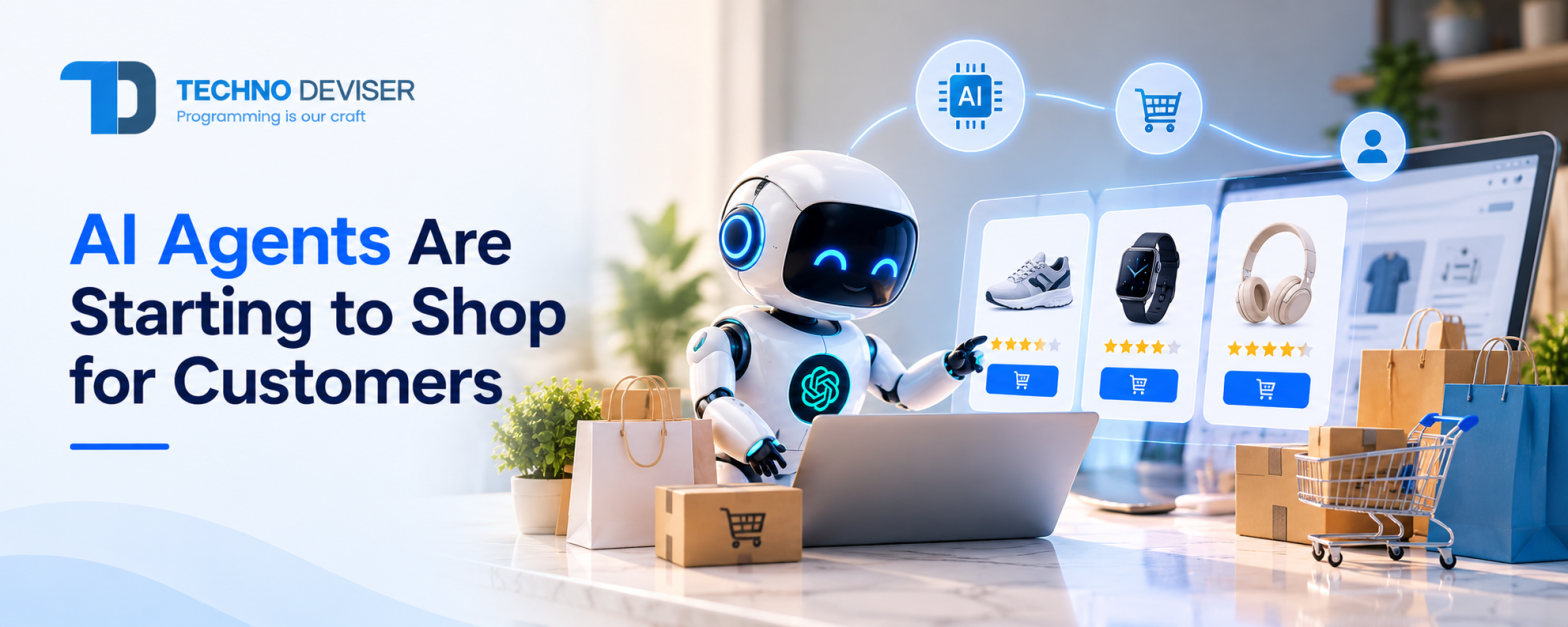
AI shopping agents are beginning to change how customers discover, compare and purchase products online. Instead of visiting several websites, checking prices manually and reading multiple product reviews, shoppers can increasingly ask an AI assistant to research products, compare alternatives and help complete purchases.
Imagine a customer asking an AI assistant to find the best running shoes under $100, compare customer reviews, check available sizes and recommend a suitable option. The AI can narrow the choices and guide the customer toward checkout without requiring them to browse every retailer individually.
This shift is creating a new opportunity for e-commerce businesses. However, it also introduces a challenge: online stores must make their products understandable not only to human shoppers and search engines but also to AI systems that may participate in purchasing decisions.
In October 2026, Shopify expanded its agentic commerce capabilities, allowing compatible AI agents to search its product catalog and support purchases through Shop Pay. Meanwhile, Google introduced its Universal Cart to simplify shopping across retailers.
These developments show that AI-assisted shopping is moving beyond product recommendations toward more complete buying experiences.
For businesses planning their next stage of digital growth, Techno Deviser’s e-commerce development services can help build and improve online stores with structured product catalogs, user-friendly shopping experiences and scalable website functionality.
But what exactly are AI shopping agents, and how can businesses prepare their stores?
Quick Answer: What Are AI Shopping Agents?
AI shopping agents are intelligent assistants that help customers research, compare, select and purchase products based on their preferences. They can analyze product details, prices, availability, reviews and delivery options. Some integrations also support checkout with customer approval. For online stores, accurate product information and reliable checkout systems are becoming increasingly important.
What Are AI Shopping Agents?
AI shopping agents are software systems that use artificial intelligence to help people complete shopping-related tasks.
Unlike a traditional search engine, which primarily displays relevant links and results, an AI shopping agent can interpret detailed customer requirements and perform multiple steps toward finding a suitable product.
For example, a customer might ask:
“Find a lightweight laptop under $900 with at least 16GB RAM, good battery life and reliable customer reviews.”
An AI assistant may compare specifications, analyze pricing, check retailer information and recommend products matching those requirements.
Moreover, some shopping agents can create shopping carts, retrieve delivery information and support payment flows through compatible commerce integrations.
However, not every AI shopping assistant can complete every transaction. The available features depend on the AI platform, merchant integration, country and payment system.
How AI Shopping Agents Differ From Chatbots
Traditional website chatbots usually answer common questions or guide visitors through predefined workflows.
AI shopping agents can handle more complicated shopping requests.
For example:
- Understand Customer preferences expressed in natural language.
- Compare Products across several criteria.
- Analyze Prices, features and availability.
- Recommend Relevant alternatives.
- Create Shopping carts through supported integrations.
- Support Checkout after customer authorization.
- Assist With order information and tracking where available.
Therefore, AI shopping agents can become digital purchasing assistants rather than simple customer service tools.
What Is Agentic Commerce?
Agentic commerce is a model of online shopping in which AI agents participate in the purchasing journey on behalf of customers.
Traditional e-commerce usually requires customers to visit online stores, browse products, compare options and complete checkout themselves.
In agentic commerce, an AI assistant can perform some of these steps based on the customer’s instructions.
For example, someone may ask an assistant to find a birthday gift within a certain budget, confirm delivery availability and prepare the order.
The system can then search for suitable products and guide the shopper through an approved purchasing flow.
The Three Main Stages of Agentic Commerce
Product Discovery
The AI agent interprets customer requirements and searches available product information.
Product Evaluation
The agent compares product attributes, prices, availability, reviews and other relevant information.
Purchase Assistance
The agent may create a shopping cart or initiate a compatible checkout flow, subject to customer authorization and platform requirements.
As a result, agentic commerce reduces some of the manual work traditionally associated with online shopping.
However, it does not eliminate the need for reliable merchants, accurate information or responsible purchasing decisions.
Why AI Shopping Is Becoming Important in 2026
AI-powered commerce has moved from experimental concepts toward practical integrations.
Several major developments in 2026 demonstrate this shift.
Shopify Opens Its Product Catalog to More AI Agents
On October 13, 2026, Shopify announced a significant expansion of its agentic commerce infrastructure.
According to Shopify’s official developer announcement, its Shop MCP allows compatible AI agents to search Shopify Catalog, build shopping carts and support checkout through Shop Pay.
The system provides access to a catalog containing more than one billion products.
Moreover, developers can connect compatible AI agents without requiring a separate API key for catalog searching.
Importantly, checkout still requires the shopper to confirm the purchase total and payment method.
For merchants, this development creates another potential route through which customers can discover products.
Google Introduces Universal Cart
Google has also expanded its AI-assisted shopping ecosystem.
On October 15, 2026, Google announced the US launch of Universal Cart across Google Search and the Gemini app.
Through Google’s Universal Cart, users can organize products from different retailers, track price changes, discover available promotions and use supported checkout options.
Furthermore, customers can complete eligible purchases through Google Pay or continue to a retailer’s website.
This development suggests that customers may increasingly manage shopping decisions through centralized AI-assisted interfaces.
OpenAI Expands AI Product Discovery
OpenAI has also introduced shopping capabilities that let ChatGPT users research products, compare options and access merchant information.
Its Agentic Commerce Protocol provides infrastructure for sharing structured product data and supporting commerce integrations.
Additionally, OpenAI’s product feed documentation describes how merchants can supply information such as product names, descriptions, prices and availability.
However, product discovery and direct checkout are separate capabilities. Direct checkout requires appropriate merchant integration and availability.
Why These Developments Matter
Together, these changes suggest that online shopping may increasingly involve three participants:
- The customer making the purchase decision.
- The AI assistant helping evaluate and select products.
- The retailer providing the products, payment processing and fulfillment.
Therefore, e-commerce businesses should prepare for a world where product information must work across both traditional shopping experiences and AI-assisted discovery systems.
How AI Shopping Agents Work
AI shopping agents combine natural language understanding, product information and integrations with commerce platforms.
Although implementations differ, the basic shopping process follows a recognizable sequence.
Step 1: The Customer Explains What They Need
Instead of entering short keywords, the customer describes their requirements.
For example:
“I need a wireless headset for office calls, under $150, compatible with my laptop and comfortable for long meetings.”
The AI interprets the requested features, budget and intended use.
Step 2: The AI Searches Product Information
The assistant retrieves available product data from supported catalogs, merchant feeds or public information sources.
This may include product titles, descriptions, specifications, prices, availability and links.
Step 3: The Agent Compares Products
The system evaluates available options against the customer’s requirements.
For example, it may compare battery life, microphone quality, compatibility and price.
However, recommendations depend on the quality and completeness of the product information available.
Step 4: The AI Presents Recommendations
The customer receives a shortlist with relevant explanations.
The assistant may also ask follow-up questions to refine the recommendations.
For example, it might ask whether the customer prefers over-ear or in-ear headphones.
Step 5: The Customer Reviews the Purchase
If the platform supports commerce integration, the agent may prepare a shopping cart or checkout session.
However, the shopper should still understand what they are buying, the full price and the applicable delivery conditions.
Step 6: The Merchant Processes the Order
Once the customer authorizes a supported transaction, the merchant processes the order through the applicable commerce and payment systems.
The retailer remains responsible for fulfilling its obligations, including delivery, customer service and returns.
As a result, AI can reduce purchasing friction without removing the merchant’s operational responsibilities.
Traditional E-Commerce vs Agentic Commerce
The following comparison explains how AI agents may change different stages of online shopping.
| Shopping Activity | Traditional E-Commerce | Agentic Commerce |
| Product search | Customers search manually | AI interprets natural-language requests |
| Product comparison | Customers compare multiple pages | AI can summarize relevant differences |
| Recommendations | Filters and recommendation widgets | Contextual recommendations based on stated needs |
| Price checking | Customers review prices individually | Agents can compare available price data |
| Availability | Shoppers check individual stores | Agents can retrieve supported inventory information |
| Checkout | Customers complete checkout themselves | Agents may prepare or facilitate approved checkout |
| Customer support | Chatbots, email and support teams | AI may assist with supported post-purchase tasks |
| Merchant visibility | Search engines, marketplaces and ads | Traditional channels plus AI-assisted product discovery |
However, agentic commerce is not a complete replacement for traditional e-commerce.
Many customers will continue browsing websites directly, comparing brands visually and making their own purchasing decisions.
Therefore, businesses should support both shopping experiences rather than abandon their existing sales channels.
Why AI Shopping Agents Matter for Online Businesses
AI shopping agents can create opportunities for businesses of different sizes.
However, the benefits depend on platform availability, product quality, customer demand and implementation.
Opportunity 1: Discover Customers Through New Channels
Traditionally, businesses invest in SEO, paid ads, marketplaces and social media to attract customers.
AI-assisted shopping introduces another product discovery channel.
For example, a customer may ask an AI assistant for a specialized product without knowing which companies sell it.
If a merchant’s product information is available through a compatible source, the product may become eligible for consideration.
This could benefit smaller businesses with well-described products that satisfy specific needs.
Opportunity 2: Help Customers Find Relevant Products
AI agents can interpret detailed customer requirements.
For example, instead of searching for “car cover,” a customer might request a waterproof outdoor car cover compatible with a particular vehicle model.
A retailer with accurate vehicle compatibility information may be better positioned to meet that request.
Therefore, detailed product data becomes increasingly valuable.
Opportunity 3: Reduce Shopping Friction
Customers often abandon purchases because the journey involves too many steps.
They may struggle to compare similar products, identify suitable variants or understand shipping conditions.
AI-assisted workflows can simplify parts of this process.
However, businesses still need reliable checkout systems, transparent policies and accurate information.
Opportunity 4: Create New E-Commerce Development Requirements
Agentic commerce increases the importance of product data architecture, catalog integrations, APIs and reliable checkout flows.
Therefore, businesses may need to improve their underlying technology.
For companies upgrading their online stores, Techno Deviser’s web and e-commerce development services can support structured shopping experiences, custom website functionality and long-term development requirements.
Is Your Online Store Ready for AI Shopping Agents?
A visually attractive website is not automatically ready for AI-assisted commerce.
Businesses need to consider how AI systems discover, interpret and use their product information.
The following areas deserve particular attention.
1. Improve Product Titles and Descriptions
AI systems depend on understandable product information.
For example, a title such as “Premium Model X” does not explain much about the product.
However, “Men’s Waterproof Hiking Jacket with Removable Hood” communicates product type, audience and key features.
Similarly, product descriptions should explain relevant specifications, intended use and compatibility.
What a Strong Product Description Should Include
- Accurate Product name
- Brand And model
- Product Category
- Key Features
- Dimensions Or sizing information
- Materials And specifications
- Compatibility Details
- Intended Use
- Available Variants
- Important Limitations
In addition, descriptions should answer common customer questions without unnecessary keyword repetition.
2. Keep Prices and Inventory Accurate
An AI agent cannot reliably recommend available products if the store publishes outdated stock information.
For example, an agent may recommend a product that appears available in a merchant feed but is actually sold out.
This creates a poor customer experience.
According to Google Merchant Center’s product data specification, prices and availability should accurately match the information presented on the product page and checkout.
Therefore, businesses should synchronize inventory, pricing and product feeds consistently.
3. Implement Relevant Product Structured Data
Structured data helps search engines interpret product information.
For e-commerce websites, Product and Offer schema can describe information such as price, currency, availability and product identity.
Google’s merchant listing structured data documentation provides implementation guidance for online retailers.
Furthermore, shipping and return information can help customers understand purchasing conditions.
However, structured data does not guarantee that an AI assistant will recommend a product.
It should be accurate, technically valid and consistent with the visible website.
4. Improve Product Feed Quality
Product feeds are becoming an important component of AI-assisted commerce.
A feed organizes product information so supported platforms can discover and evaluate items more efficiently.
For example, OpenAI’s product feed best practices emphasize factual product descriptions, accurate variants and consistent seller information.
Businesses should review whether their product feeds include complete identifiers, product attributes, images, pricing and stock details.
Moreover, a feed should update when products change.
5. Make Product Variants Easy to Understand
Product variants can create confusion when a store does not structure them properly.
For example, a shoe retailer may offer several colors and sizes. However, not every combination may be available.
Therefore, product data should distinguish the available combinations clearly.
The same principle applies to vehicle-specific accessories, electronics and products with multiple dimensions.
6. Publish Clear Shipping and Return Policies
AI shopping assistants may need to answer questions about delivery time, return eligibility and refund conditions.
Therefore, businesses should publish understandable policies that accurately describe their operations.
For example, a store should clearly explain whether it accepts returns on customized products.
Additionally, policy information should remain consistent across the website, product feeds and supported sales integrations.
7. Maintain Secure Checkout Systems
Even when an AI agent assists with shopping, the customer still needs a trustworthy purchasing experience.
Businesses should use appropriate payment providers, secure authentication and reliable order processing.
Moreover, checkout totals should accurately reflect taxes, shipping charges and discounts.
Never rely on AI-generated text alone to determine a final payment amount.
Instead, the commerce backend should calculate and confirm authoritative order details.
8. Review Platform Eligibility
Not every e-commerce platform offers the same agentic commerce features.
Shopify merchants should review their available Agentic Storefronts channels.
Other merchants should evaluate relevant integrations, product feed requirements and platform-specific commerce capabilities.
Furthermore, availability can vary by country and sales channel.
Therefore, businesses should confirm current eligibility before committing resources.
9. Improve Website Speed and Mobile Usability
AI shopping agents do not eliminate the need for a strong website.
Many customers will still visit product pages, read detailed information or complete checkout directly.
Therefore, page speed, mobile navigation and checkout usability remain important.
A store that loads slowly or has broken purchase buttons can still lose customers even when AI helps them discover products.
10. Build Strong Brand Information
A product listing alone may not answer every customer question.
Shoppers may want to understand the retailer’s credibility, customer support process, warranty or return policy.
Therefore, businesses should maintain accurate About Us, Contact Us, Shipping, Returns and FAQ pages.
Moreover, genuine product reviews and clear business information can support customer confidence.
How Shopify Is Preparing for Agentic Commerce
Shopify has become one of the most visible platforms developing infrastructure for AI-assisted online shopping.
Its Agentic Storefronts allow eligible merchants to make products available through supported AI channels.
According to the Shopify Help Center, merchants can manage supported agentic channels through their Shopify admin.
Shopify Catalog helps organize product information for AI-assisted discovery.
Additionally, merchants can access reporting for supported AI commerce activity.
Shopify’s Shop MCP Development
The October 2026 Shop MCP update expands access for compatible AI agents.
Its capabilities include product searching, cart creation, supported checkout and order tracking.
However, integration details still depend on the agent, shopper authentication and available payment capabilities.
For Shopify store owners, the immediate priority should be reviewing catalog quality and available sales channel settings.
There is no reason to rebuild a functioning store simply because AI shopping is growing.
Instead, businesses should start by improving product information and validating their existing commerce infrastructure.
What About WooCommerce, Magento and Custom E-Commerce Stores?
AI shopping is not limited to Shopify.
However, different platforms require different approaches to product discovery and commerce integration.
WooCommerce Stores
WooCommerce businesses can begin by improving product descriptions, structured data, inventory synchronization and checkout reliability.
Moreover, merchants should review compatible product feed integrations and available AI commerce connections.
A clean WooCommerce catalog creates a stronger foundation for future agentic commerce implementations.
Magento and Adobe Commerce Stores
Magento-based businesses often manage complex product catalogs, customer groups and pricing structures.
Therefore, agentic readiness may require careful work around product identifiers, variant relationships, APIs and inventory synchronization.
Additionally, development teams should ensure that external integrations cannot bypass important pricing or authorization rules.
Custom E-Commerce Platforms
Custom stores may need more technical planning.
For example, developers may need to build or adapt product feed exports, APIs, catalog synchronization and checkout integrations.
However, businesses should not assume that every AI platform provides unrestricted merchant integration.
OpenAI’s agentic commerce onboarding documentation identifies current requirements for approved product feed integrations.
For companies building or upgrading custom commerce systems, Techno Deviser’s e-commerce development team can help evaluate the website architecture, shopping experience and development requirements.
How AI Shopping Changes E-Commerce SEO
AI shopping does not make traditional SEO irrelevant.
Instead, it increases the importance of accurate product information and discoverable website content.
E-commerce SEO already involves optimizing product pages, category pages, internal links, structured data and technical website quality.
These elements remain useful because they help customers and search systems understand what a retailer sells.
However, AI-assisted discovery also creates a stronger need for detailed product attributes and reliable catalog feeds.
SEO vs AI Shopping Optimization
Traditional e-commerce SEO often focuses on helping a product page appear for relevant search queries.
AI shopping optimization additionally considers whether compatible agents can identify the product’s specifications, price, availability and purchasing conditions.
For example, a product page optimized for “best office chair” may still lack important details about weight capacity, dimensions and adjustability.
An AI shopping assistant evaluating detailed ergonomic requirements may need those attributes.
Therefore, retailers should focus on accurate specifications rather than repeating promotional keywords.
Does llms.txt Help AI Shopping Agents?
An llms.txt file can provide a structured overview of website content for tools that choose to use it.
However, it is not a replacement for product feeds, Product structured data or official commerce integrations.
Furthermore, there is no general guarantee that publishing llms.txt will cause shopping agents to recommend a store.
For e-commerce businesses, accurate catalog information should remain the priority.
In addition, Techno Deviser’s SEO services can support the content and technical foundations that help online stores remain discoverable across traditional search experiences.
Real-World Shopping Scenarios: Where AI Agents Can Help
The following hypothetical examples illustrate how AI-assisted shopping could work across different industries. They are not claims of measured campaign results.
Example 1: Automotive Accessories
A customer asks:
“Find a waterproof outdoor car cover compatible with my vehicle and suitable for heavy rain.”
An AI shopping assistant can search product information for vehicle compatibility, material, weather protection and price.
If the retailer provides complete fitment data, the assistant has more information to evaluate suitable options.
However, missing compatibility details may prevent a confident recommendation.
Example 2: Beauty and Hair Styling Products
A shopper requests:
“Recommend a hair straightener for thick hair with adjustable temperature settings and international voltage support.”
The AI may compare temperature ranges, plate materials, voltage compatibility and product prices.
As a result, retailers that publish clear technical specifications can better support detailed shopping requests.
Example 3: Home and Furniture Products
A customer asks:
“Find a compact office desk under $250 that fits a small room and includes storage.”
The assistant can compare product dimensions, materials, assembly requirements and pricing.
However, unclear measurements or missing product images can limit the usefulness of the recommendations.
What These Examples Teach Businesses
Across industries, one principle remains consistent: AI systems need reliable information.
Therefore, retailers should publish product information that answers real customer questions.
In many cases, improving existing product content can be more valuable than introducing another AI tool without a clear business purpose.
Challenges and Risks of Agentic Commerce
AI-assisted shopping creates opportunities, but businesses should consider operational and customer risks before adopting new tools.
Incorrect Product Recommendations
AI systems can misunderstand customer requirements or use incomplete product data.
For example, recommending the wrong vehicle component or an incompatible electronic accessory may create customer dissatisfaction.
Therefore, technical specifications and compatibility information must be accurate.
Product Pricing Errors
A mismatch between displayed prices and checkout totals can create confusion.
Consequently, merchants should rely on authoritative backend pricing rather than AI-generated estimates.
Customer Privacy
AI-assisted shopping may involve preferences, shopping history, delivery information and payment workflows.
Businesses should use trusted integrations and follow applicable privacy requirements.
In addition, customer information should only be shared when necessary for the relevant transaction.
Fraud and Unauthorized Purchasing
Automation must not bypass customer authorization or payment security.
For example, Shopify’s Shop MCP documentation specifies that customers confirm the purchase total and payment method before supported checkout completion.
Therefore, businesses should maintain proper authentication and transaction controls.
Dependence on Third-Party Platforms
Retailers may gain visibility through AI shopping services but also become more dependent on external distribution channels.
Moreover, different platforms may have different fees, attribution methods and customer interaction rules.
This makes it important to preserve a strong direct-to-consumer website and customer relationship.
How to Measure AI Shopping Performance
Businesses should avoid measuring AI commerce success only through product impressions or mentions.
Instead, they should connect discovery and shopping activity to meaningful commercial outcomes.
Some platforms now provide attribution or sales reporting for supported agentic channels.
However, reporting methods may differ, and not every interaction will appear as a traditional website session.
Important E-Commerce Metrics
Businesses should monitor:
- Product Discovery activity from supported AI channels
- AI-Referred website traffic
- Product Page engagement
- Cart Creation and checkout starts
- Completed Purchases
- Conversion Rate by channel
- Average Order Value
- Customer Acquisition Cost
- Refund And return rates
- Revenue From attributable AI-assisted orders
Furthermore, compare performance against existing organic, paid and direct traffic channels.
A new AI shopping channel is only valuable when it supports the business’s overall goals.
A Practical 30-Day AI Commerce Readiness Plan
Businesses do not need to implement everything immediately.
A structured plan can help identify the most valuable improvements first.
Week 1: Audit Your Product Catalog
Review the accuracy and completeness of product information.
Prioritize high-selling products and items with complicated specifications.
Key tasks include:
- Check Product titles and descriptions.
- Review Prices and stock information.
- Identify Missing product attributes.
- Correct Variant and compatibility information.
- Review Product images and category assignments.
Week 2: Improve Technical E-Commerce Foundations
Focus on structured product information and reliable shopping functionality.
Key tasks include:
- Validate Product and Offer structured data.
- Review Google Merchant Center diagnostics.
- Confirm Product feed synchronization.
- Test Checkout and cart functionality.
- Review Mobile website performance.
Additionally, identify technical issues that could prevent supported integrations from retrieving accurate information.
Week 3: Review AI Shopping Opportunities
Investigate currently available commerce integrations.
For Shopify stores, review Agentic Storefronts and channel eligibility.
For other platforms, evaluate documented product feed and checkout options.
Key tasks include:
- Review Platform-supported AI commerce channels.
- Understand Country and merchant eligibility.
- Check Available product feed integrations.
- Evaluate Customer authorization requirements.
- Test Supported product discovery where possible.
Week 4: Establish Measurement and Improvement
Once the technical foundation is in place, establish reporting and maintenance processes.
Key tasks include:
- Configure Available AI channel attribution.
- Review Product discovery performance.
- Monitor Checkout and order errors.
- Collect Customer feedback.
- Prioritize Further catalog improvements.
- Create An ongoing review schedule.
As a result, businesses can prepare for AI shopping without unnecessary development costs.
Expert Insight: Shopify’s Perspective on AI Commerce
Shopify CEO Tobi Lütke described the company’s direction in its Agentic Storefronts announcement:
“We’re making every Shopify store agent-ready by default.”
This statement reflects the growing importance of commerce infrastructure that allows products to participate in AI-driven shopping experiences.
However, businesses should not interpret it as a guarantee that every product will appear in every AI assistant.
The commercial opportunity still depends on product relevance, catalog quality, platform eligibility and customer demand.
For retailers, the lesson is clear: AI commerce readiness begins with dependable product information and a functional shopping system.
Frequently Asked Questions
What are AI shopping agents?
AI shopping agents are intelligent assistants that help customers research, compare and select products. Some supported integrations also allow agents to create carts, assist with checkout and retrieve order information.
Can AI agents purchase products without customer approval?
Some systems can automate several shopping steps. However, supported payment integrations generally require customer authorization. For example, Shopify's Shop MCP requires the shopper to confirm the purchase total and payment method before checkout completion.
Do Shopify stores support AI shopping agents?
Yes. Shopify offers Agentic Storefronts for eligible merchants and has expanded access through Shop MCP. Available discovery and checkout capabilities vary by channel, merchant eligibility and region.
Can WooCommerce websites prepare for agentic commerce?
Yes. WooCommerce stores can improve product data, structured markup, inventory synchronization and checkout reliability. Direct AI shopping integrations depend on the specific platform and available tools.
Does agentic commerce replace traditional SEO?
No. Traditional SEO remains important for product discovery, organic traffic and brand visibility. AI shopping adds new requirements around structured product information, feeds and commerce integrations.
How can small e-commerce businesses prepare for AI shopping?
Small businesses should start by improving product titles, descriptions, specifications, prices and inventory accuracy. They should also review structured data, product feeds, customer policies and platform eligibility before investing in advanced integrations.
Will AI shopping agents increase online sales?
They may create additional sales opportunities by helping customers discover relevant products and reducing friction. However, results depend on customer adoption, product competitiveness, merchant eligibility and the quality of the shopping experience.
Can Techno Deviser help build an AI-ready e-commerce website?
Techno Deviser provides e-commerce development, web application development, UI/UX design and SEO services. Businesses can discuss product catalog improvements, integrations, website performance and custom commerce requirements with the development team.
Table of Content
- Introduction
- Quick Answer: What Are AI Shopping Agents?
- What Are AI Shopping Agents?
- What Is Agentic Commerce?
- Why AI Shopping Is Becoming Important in 2026
- How AI Shopping Agents Work
- Traditional E-Commerce vs Agentic Commerce
- Why AI Shopping Agents Matter for Online Businesses
- Is Your Online Store Ready for AI Shopping Agents?
- How Shopify Is Preparing for Agentic Commerce
- What About WooCommerce, Magento and Custom E-Commerce Stores?
- How AI Shopping Changes E-Commerce SEO
- Real-World Shopping Scenarios: Where AI Agents Can Help
- Challenges and Risks of Agentic Commerce
- How to Measure AI Shopping Performance
- A Practical 30-Day AI Commerce Readiness Plan
- Expert Insight: Shopify’s Perspective on AI Commerce
- Frequently Asked Questions
Leave a comment
Your email address will not be published. Required fields are marked *
Techno Deviser