




-
 Jul 13, 2026
-
 Techno Deviser
-
 13 min read
- What Are Google Performance Max Campaigns?
- Why Performance Max Matters in 2026
- How Performance Max Works
- Performance Max vs Search Campaigns
- Who Should Use Performance Max?
- Key Elements of a Successful PMax Campaign
- Audience Signals in Performance Max
- Conversion Tracking and GA4 Setup
- Budget and Bidding Strategy
- Final URL Expansion and Landing Pages
- Creative Assets for Better Results
- Common Performance Max Mistakes
- Monthly Optimization Checklist
- Performance Max for E-Commerce
- How Techno Deviser Helps with PPC Growth
- Mini Case Study Example
- Expert Quote
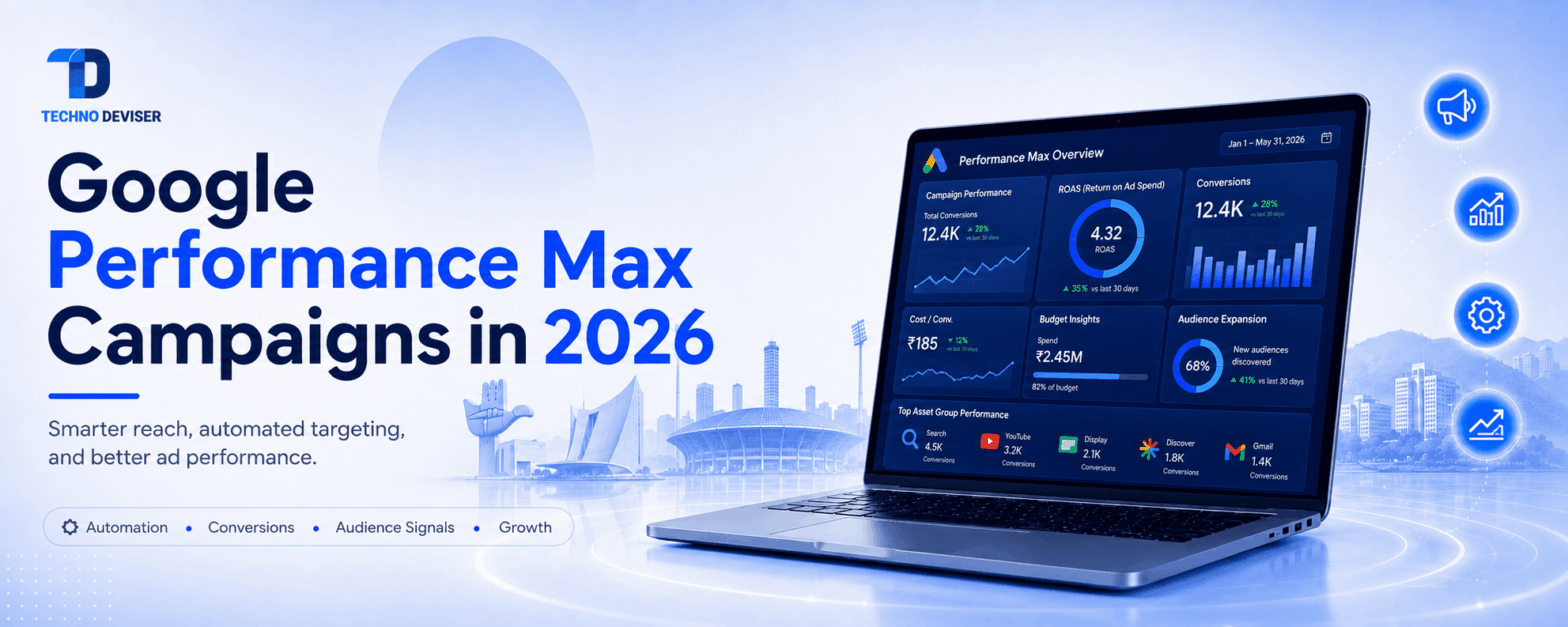
Google Performance Max campaigns are goal-based Google Ads campaigns that use Google AI to show ads across Search, Display, YouTube, Discover, Gmail and Maps from one campaign. In 2026, businesses can use Performance Max to improve reach, leads and sales, but success depends on accurate conversion tracking, strong creative assets, clear goals, good landing pages and regular campaign optimization.
What Are Google Performance Max Campaigns?
Google Performance Max campaigns, also called PMax campaigns, are goal-based Google Ads campaigns designed to help advertisers reach customers across multiple Google channels from one campaign.
Instead of creating separate campaigns for Search, Display, YouTube, Discover, Gmail and Maps, advertisers can use one Performance Max campaign to access different Google placements. The campaign uses Google AI to decide where ads should appear, which assets should be combined and which users are more likely to convert.
This makes Performance Max powerful, but it also means businesses need the right setup. A weak campaign structure, poor tracking or low-quality creative assets can waste budget quickly.
For businesses that want professional campaign planning, Techno Deviser PPC advertising can help create paid ad strategies focused on visibility, traffic and conversions.
Why Performance Max Matters in 2026
Digital advertising has changed. Businesses now need campaigns that can reach users across different touchpoints. A customer may watch a YouTube video, search on Google, check Gmail, browse Discover and compare products before taking action.
Performance Max helps businesses appear across these channels using one campaign. This is useful because customer journeys are no longer simple. People do not always search once and convert immediately.
In 2026, Performance Max matters because:
- Google Ads is becoming more AI-driven
- Customers move across many digital channels
- Businesses need better conversion tracking
- Creative assets are becoming more important
- First-party data matters more
- Landing page quality affects paid ad results
- Automation needs human strategy
However, Performance Max should not be treated as a “set and forget” campaign. It needs planning, monitoring and regular optimization.
How Performance Max Works
Performance Max works by using your business goals, conversion actions, budget, bidding strategy, creative assets, product feed, landing pages and audience signals. Google’s system then uses these inputs to find users who are more likely to convert.
A Performance Max campaign usually includes:
- Campaign goal
- Budget
- Bidding strategy
- Asset groups
- Text assets
- Image assets
- Video assets
- Logo assets
- Audience signals
- Conversion actions
- Landing pages
- Location and language settings
The campaign does not work like a traditional keyword-only search campaign. Instead of targeting only selected keywords, Performance Max uses Google AI and available signals to find conversion opportunities across different Google channels.
This means your inputs matter a lot. Better data, better assets and better landing pages usually give the system stronger signals.
Performance Max vs Search Campaigns
Performance Max and Search campaigns are not the same. Both can be useful, but they serve different purposes.
| Feature | Search Campaigns | Performance Max Campaigns |
| Main Targeting | Keywords | AI-driven signals and goals |
| Channels | Google Search | Search, Display, YouTube, Discover, Gmail and Maps |
| Control Level | Higher keyword control | Lower manual control |
| Best Use | High-intent searches | Multi-channel growth |
| Creative Need | Text ads mainly | Text, images, videos and logos |
| Reporting | More search query visibility | More automated insights |
| Ideal Setup | Keyword-focused strategy | Goal and asset-focused strategy |
Search campaigns are still very important, especially for high-intent keywords. Performance Max can work well when it supports an already strong Google Ads structure.
For many businesses, the best strategy is not Search vs Performance Max. It is Search plus Performance Max.
Who Should Use Performance Max?
Performance Max can work for many businesses, but it is not perfect for every situation.
1. E-Commerce Businesses
E-commerce businesses can use Performance Max to promote products across Shopping, Search, Display, YouTube and other Google channels. It works especially well when the product feed is clean, product titles are optimized and conversion tracking is accurate.
2. Lead Generation Businesses
Service businesses can use PMax for leads, but they must track lead quality. If the campaign only tracks form submissions, Google may optimize for low-quality leads. A better setup includes qualified leads, CRM data or offline conversion imports.
3. Local Businesses
Clinics, showrooms, restaurants, education centers and local service providers can use Performance Max to drive calls, direction requests, store visits and local actions.
4. SaaS and B2B Companies
B2B companies can use Performance Max, but they need strong tracking and enough conversion volume. For longer sales cycles, offline conversion tracking becomes very important.
5. Key Elements of a Successful PMax Campaign
- Clear Campaign Goal
Every campaign should start with a clear goal. Do you want leads, online sales, calls, store visits or sign-ups?
Without a clear goal, the campaign may optimize toward the wrong result.
- Accurate Conversion Tracking
Performance Max depends on conversion data. If tracking is wrong, the campaign may optimize incorrectly.
Track meaningful actions such as:
- Purchases
- Qualified leads
- Phone calls
- Form submissions
- Bookings
- Sign-ups
- Store visits
- High-value engagement
Avoid giving too much value to weak actions such as page views or basic button clicks.
- Strong Asset Groups
Asset groups are collections of text, images, videos, logos and audience signals. They should be organized by theme, product category, service type or audience intent.
For example, a digital marketing company may create separate asset groups for SEO, PPC, website development and e-commerce services.
- High-Quality Creative Assets
Performance Max needs strong creative assets because it runs across visual and text-based placements. Businesses should use clear images, short videos, logos, headlines and descriptions.
Weak creative assets can reduce campaign performance.
- Good Landing Pages
A campaign can send traffic, but landing pages convert visitors. A slow, confusing or poorly written landing page can waste ad spend.
A strong landing page should include:
- Clear headline
- Strong offer
- Service details
- Trust signals
- Simple form
- Fast speed
- Mobile-friendly design
- Clear call-to-action
- Relevant FAQs
Businesses that need better landing pages can explore Techno Deviser web and e-commerce development.
Brands Looking for Incremental Growth
Businesses with stable Search campaigns can use Performance Max to expand reach and find additional conversions across Google’s network.
Key Elements of a Successful PMax Campaign
1. Clear Campaign Goal
Every campaign should start with a clear goal. Do you want leads, online sales, calls, store visits or sign-ups?
Without a clear goal, the campaign may optimize toward the wrong result.
2. Accurate Conversion Tracking
Performance Max depends on conversion data. If tracking is wrong, the campaign may optimize incorrectly.
Track meaningful actions such as:
- Purchases
- Qualified leads
- Phone calls
- Form submissions
- Bookings
- Sign-ups
- Store visits
- High-value engagement
Avoid giving too much value to weak actions such as page views or basic button clicks.
3. Strong Asset Groups
Asset groups are collections of text, images, videos, logos and audience signals. They should be organized by theme, product category, service type or audience intent.
For example, a digital marketing company may create separate asset groups for SEO, PPC, website development and e-commerce services.
4. High-Quality Creative Assets
Performance Max needs strong creative assets because it runs across visual and text-based placements. Businesses should use clear images, short videos, logos, headlines and descriptions.
Weak creative assets can reduce campaign performance.
5. Good Landing Pages
A campaign can send traffic, but landing pages convert visitors. A slow, confusing or poorly written landing page can waste ad spend.
A strong landing page should include:
- Clear headline
- Strong offer
- Service details
- Trust signals
- Simple form
- Fast speed
- Mobile-friendly design
- Clear call-to-action
- Relevant FAQs
Businesses that need better landing pages can explore Techno Deviser web and e-commerce development.
Audience Signals in Performance Max
Audience signals help guide Google AI. They are not strict targeting rules, but they give Google a better starting point.
Good audience signals may include:
- Website visitors
- Customer lists
- Cart abandoners
- Past buyers
- High-value leads
- Custom segments
- Search-based intent
- Interest-based audiences
- GA4 audiences
For example, an e-commerce brand can use past buyers and product page visitors as signals. A service business can use website visitors, lead form users and high-intent keyword-based custom segments.
Audience signals should match the asset group theme. If an asset group promotes PPC services, the audience signal should relate to users interested in Google Ads, lead generation or paid marketing.
Conversion Tracking and GA4 Setup
Conversion tracking is one of the most important parts of Performance Max. Without tracking, Google AI does not know which users are valuable.
A strong tracking setup may include:
- Google Ads conversion actions
- GA4 events
- Form submission tracking
- Phone call tracking
- E-commerce purchase tracking
- Enhanced conversions
- Offline conversion imports
- CRM lead quality data
For lead generation businesses, tracking only form submissions is often not enough. A campaign may generate many leads, but not all leads are valuable. Therefore, businesses should track qualified leads, booked calls, sales opportunities and closed deals wherever possible.
This helps Performance Max optimize for business value instead of only lead volume.
Budget and Bidding Strategy
Performance Max needs enough budget to learn. If the budget is too small, the campaign may struggle to collect useful data.
Common bidding strategies include:
- Maximize Conversions
- Maximize Conversion Value
- Target CPA
- Target ROAS
For new campaigns, many businesses start with Maximize Conversions until enough data is collected. Later, they may add Target CPA or Target ROAS depending on the business goal.
E-commerce businesses often use Target ROAS when order values vary. Lead generation businesses may use Target CPA when lead quality and conversion values are stable.
Avoid changing budgets and bid strategies too frequently. Major changes can disturb the learning process.
Final URL Expansion and Landing Pages
Final URL expansion allows Performance Max to send users to different relevant pages on your website, not only the final URL you provide. This can help Google find better landing pages, but it can also send traffic to pages that are not built for conversion.
For example, a campaign may send users to blog pages, old service pages or weak landing pages if exclusions are not managed properly.
Businesses should review landing page reports and exclude pages that should not receive paid traffic, such as:
- Career pages
- Old blogs
- Policy pages
- Thank-you pages
- Low-quality pages
- Irrelevant service pages
- Pages with poor conversion rates
If you want full landing page control, you may turn off Final URL expansion. However, for many campaigns, a better option is to keep it controlled with URL exclusions.
Creative Assets for Better Results
Performance Max is creative-heavy. It needs multiple assets to test across different placements.
Important creative assets include:
- Headlines
- Long headlines
- Descriptions
- Images
- Logos
- Videos
- Product images
- Lifestyle images
- Call-to-action text
Text Assets
Text assets should focus on real business benefits. Avoid generic lines such as “best service provider.” Instead, use specific value.
Examples:
- Get more qualified leads with expert PPC
- Launch a faster e-commerce website
- Improve local visibility with SEO
- Book a free digital growth consultation
Image Assets
Images should look professional and match the brand. Avoid too much text inside images because it may get cropped on different placements.
Video Assets
Video is important because Performance Max can show ads on YouTube. A short 15–30 second video can explain the offer, show the product or build trust.
If no video is provided, Google may generate videos automatically from available assets. However, branded custom videos usually look better.
Common Performance Max Mistakes
1. Poor Conversion Tracking
If conversions are not tracked correctly, the campaign cannot optimize properly.
2. Mixing All Goals Together
Do not mix purchases, weak leads, page views and low-value actions into one campaign goal without proper value settings.
3. Using Weak Creative Assets
Low-quality images, generic headlines and missing videos can limit performance.
4. Ignoring Lead Quality
A campaign may generate many leads, but not all leads become customers. Track qualified leads whenever possible.
5. Poor Landing Pages
Even strong campaigns fail when landing pages are slow, confusing or not mobile-friendly.
6. No URL Exclusions
Without URL exclusions, Performance Max may send traffic to pages that are not suitable for paid campaigns.
7. Too Many Campaigns with Small Budgets
Over-fragmenting campaigns can reduce learning. It is better to use fewer well-structured campaigns.
8. Changing Settings Too Often
Frequent changes can reset learning and make results unstable.
9. Ignoring Search Campaigns
Performance Max should usually support Search campaigns, not completely replace them.
10. Not Reviewing Reports
Performance Max still needs regular review. Do not leave it running without checking performance.
Monthly Optimization Checklist
Use this checklist to keep Performance Max campaigns healthy:
- Review conversion tracking
- Check lead quality
- Analyze asset group performance
- Refresh weak creative assets
- Review landing pages
- Add URL exclusions
- Check audience insights
- Compare CPA or ROAS
- Review location performance
- Check device performance
- Monitor budget usage
- Review search categories
- Update seasonal offers
- Test landing page improvements
- Compare PMax with Search campaigns
Optimization should be consistent, not random. Businesses should review performance regularly and make changes based on data.
Performance Max for E-Commerce
For e-commerce brands, Performance Max can be powerful when connected with Google Merchant Center.
Important e-commerce setup areas include:
- Clean product feed
- Optimized product titles
- High-quality product images
- Correct product categories
- Accurate prices
- Strong product descriptions
- Conversion tracking
- Purchase value tracking
- Remarketing audiences
- Product category asset groups
E-commerce businesses should also review product-level performance. Some products may spend budget without generating profitable sales. Others may perform better and deserve more focus.
Performance Max for Lead Generation
For lead generation, Performance Max needs careful setup. The main risk is optimizing for low-quality leads.
To improve lead quality:
- Use clear lead forms
- Ask qualifying questions
- Track phone calls
- Import CRM lead quality
- Use offline conversions
- Exclude poor landing pages
- Use strong audience signals
- Monitor spam leads
- Connect PPC with sales feedback
For service businesses, quality matters more than lead count. Ten qualified leads are better than fifty poor leads.
Techno Deviser already has helpful PPC content such as Why Google Ads Are Not Generating Leads in 2026, which can support internal linking for readers who want to improve lead quality.
How Techno Deviser Helps with PPC Growth
Techno Deviser helps businesses build stronger digital growth systems through PPC, SEO, website development, e-commerce development, mobile apps, SMO, hosting and maintenance.
For Performance Max campaigns, Techno Deviser can support businesses with:
- PPC strategy planning
- Google Ads setup
- Campaign structure
- Conversion tracking
- Landing page improvement
- Audience signal planning
- Creative asset direction
- Budget planning
- Campaign optimization
- Reporting and performance review
- Lead quality improvement
- SEO and PPC alignment
The main advantage of working with Techno Deviser is that PPC does not stay separate from the website. Paid ads work better when the landing page, website speed, SEO structure, content and conversion path are also strong.
Businesses can explore PPC advertising services for paid campaign support, SEO services for organic growth and Techno Deviser services for complete digital support.
Mini Case Study Example
A local service business runs Google Ads but receives poor-quality leads. The campaign has clicks, but very few inquiries become paying customers.
After review, the main issues are:
- No proper conversion tracking
- Weak landing page content
- No lead qualification questions
- Generic ad messaging
- No call tracking
- PMax traffic going to old blog pages
- No CRM feedback
A better Performance Max setup would include:
- Dedicated landing page
- Clear service offer
- Strong form questions
- Phone call tracking
- Qualified lead conversion action
- URL exclusions
- Better images and videos
With this setup, the campaign can focus more on quality leads instead of only form submissions.
Expert Quote
“Performance Max can help businesses scale Google Ads, but automation works best when the foundation is strong. Clear goals, accurate tracking, strong landing pages and regular optimization decide whether PMax becomes a growth channel or a budget leak.”
Table of Content
- What Are Google Performance Max Campaigns?
- Why Performance Max Matters in 2026
- How Performance Max Works
- Performance Max vs Search Campaigns
- Who Should Use Performance Max?
- Key Elements of a Successful PMax Campaign
- Audience Signals in Performance Max
- Conversion Tracking and GA4 Setup
- Budget and Bidding Strategy
- Final URL Expansion and Landing Pages
- Creative Assets for Better Results
- Common Performance Max Mistakes
- Monthly Optimization Checklist
- Performance Max for E-Commerce
- How Techno Deviser Helps with PPC Growth
- Mini Case Study Example
- Expert Quote
Leave a comment
Your email address will not be published. Required fields are marked *