




-
 May 22, 2026
-
 Techno Deviser
-
 17 min read
- Introduction
- Why website errors cost businesses leads
- What AI website monitoring means
- How AI detects website downtime
- How AI detects slow page performance
- How AI detects form and checkout errors
- How AI detects broken links and missing pages
- How AI detects security and malware issues
- How AI detects SEO and indexing problems
- How AI detects user behavior problems
- How AI helps teams prioritize fixes
- Comparison table: Manual monitoring vs AI website monitoring
- Mini case study: How AI website monitoring saves a lead campaign
- Practical AI website monitoring checklist
- Common mistakes to avoid
- Expert quote
- FAQs
Introduction
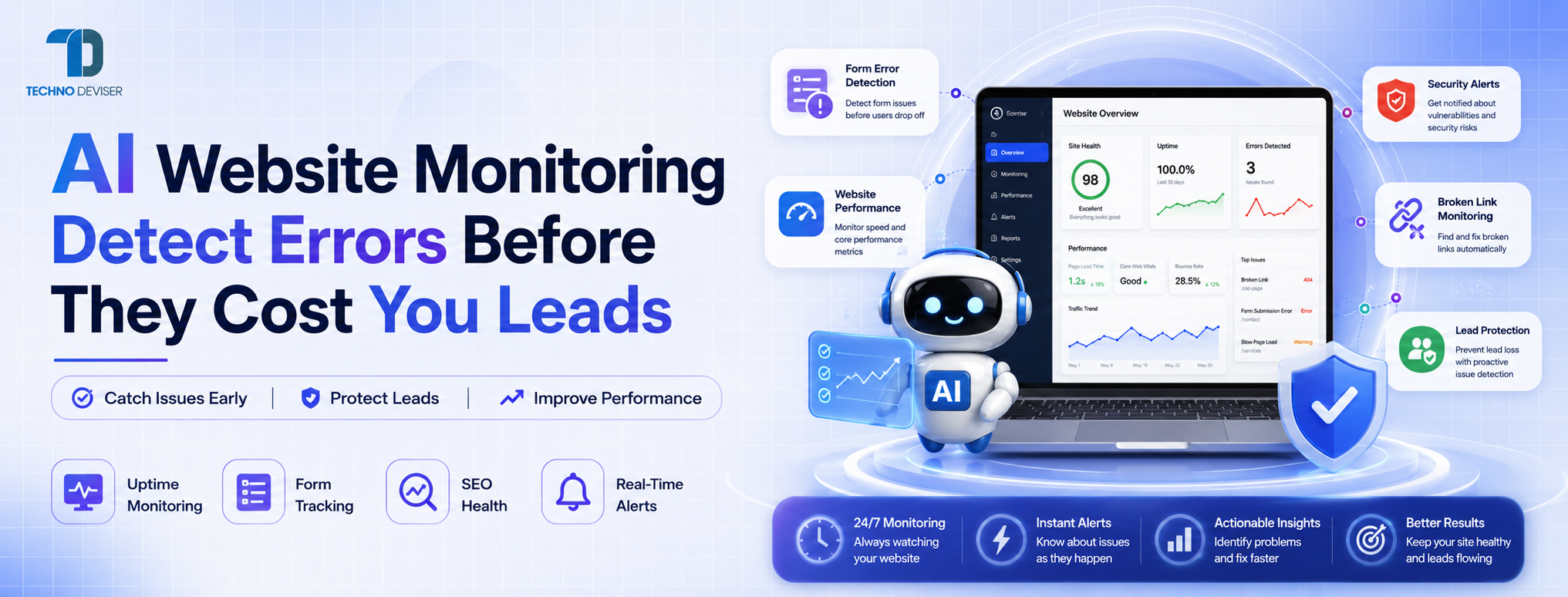
AI website monitoring helps businesses detect website errors before they lose leads, sales, bookings, or customer trust. A website can look normal on the surface while contact forms fail, checkout pages break, pages load slowly, buttons stop working, or users leave because of hidden technical issues. Therefore, businesses need smarter monitoring that finds problems early.
Moreover, modern websites are connected to many moving parts. A business website may depend on hosting, CMS updates, plugins, forms, scripts, payment gateways, analytics tools, tracking codes, landing pages, and SEO settings. If one small part breaks, the website can lose valuable inquiries.
For businesses that rely on their website for calls, forms, sales, bookings, or consultations, Techno Deviser’s web app and e-commerce development services can support stronger website planning, development, maintenance, and digital growth. Techno Deviser also lists services such as web development, mobile app development, SEO, PPC, SMO, quality assurance, and web hosting and maintenance, which makes website monitoring an important part of long-term online performance.
However, AI should not replace professional website support. Instead, it should help teams find errors faster, understand risk clearly, and fix problems before visitors leave.
AI website monitoring detects errors before they cost leads by tracking uptime, speed, forms, checkout steps, broken links, security risks, user behavior, and SEO health. It identifies unusual patterns, sends alerts, and helps teams prioritize urgent issues so businesses can fix problems before visitors abandon the website or contact competitors.
Why website errors cost businesses leads
A website error does not always look dramatic. Sometimes the homepage still loads, but the lead form fails and the contact button works on desktop but not on mobile. Sometimes a landing page loads slowly only for users in certain locations.
However, each of these problems can cost leads. If a visitor cannot submit a form, book a consultation, complete checkout, or find the right page, the business may never know the lead was lost.
In addition, website performance affects user experience. Google’s Core Web Vitals documentation explains that these metrics help site owners measure real-world user experience across loading, responsiveness, and visual stability. Therefore, a slow or unstable website can create friction before a visitor converts.
Moreover, many lead losses happen silently. A business owner may assume fewer inquiries mean lower demand. In reality, the website may have broken forms, slow mobile pages, tracking problems, or errors after a plugin update.
How small errors create big lead problems
Small website errors can hurt a business in several ways:
- Stop users from submitting forms
- Make phone buttons difficult to tap
- Break checkout or booking steps
- Slow down important landing pages
- Send visitors to 404 pages
- Hide calls to action on mobile
- Cause tracking data to disappear
- Trigger security warnings
- Reduce trust before contact
- Create poor first impressions
As a result, website monitoring is not just a technical task. It is a lead protection strategy.
What AI website monitoring means
AI website monitoring means using artificial intelligence to watch website health, detect unusual activity, and explain problems faster than manual checks alone. It can review performance data, traffic behavior, form activity, server signals, security alerts, and user paths.
Traditional monitoring often tells a team when a website is down. However, AI website monitoring can go further. It can detect patterns that show something may be wrong, even when the website is technically online.
For example, AI may notice that form submissions dropped suddenly after a website update. It may also detect that mobile users are abandoning a checkout page more often than usual. Similarly, it may find that page speed dropped after a new script was added.
Furthermore, businesses can combine monitoring with SEO services, because technical errors, slow pages, broken links, and poor page experience can affect both conversions and search performance. Techno Deviser’s SEO page includes technical SEO, SEO audits, analytics and reporting, and content optimization among its services.
What AI website monitoring can track
AI can monitor:
- Website uptime
- Page speed
- Core Web Vitals
- Contact forms
- Quote forms
- Booking systems
- Checkout pages
- Broken links
- 404 errors
- Security alerts
- Malware signs
- Suspicious traffic
- SEO issues
- Conversion drops
- Mobile usability problems
Additionally, AI can summarize issues in plain language. This helps business owners understand which problems need quick attention.
How AI detects website downtime
Downtime is one of the clearest website problems. If a website goes offline, visitors cannot contact the business, read service pages, book appointments, or buy products.
However, downtime can be partial. A homepage may work while a booking page fails. A desktop version may load while mobile users face errors. A server may slow down before it fully stops responding.
AI monitoring can check website availability from different devices, browsers, and locations. It can also compare normal traffic patterns with sudden drops. Therefore, if the website usually gets form submissions every morning but suddenly gets none, AI can flag the issue.
Moreover, uptime monitoring becomes more valuable when it connects to business pages. For example, a service page, checkout page, PPC landing page, or contact page should receive stronger monitoring than a low-traffic archive page.
For companies running ads, a broken landing page can waste budget quickly. Therefore, businesses using PPC should connect landing page monitoring with campaign performance. PPC advertising services focus on targeted traffic, landing page optimization, conversion monitoring, and campaign performance, so reliable landing pages matter for ad results.
Downtime signals AI can detect
AI can detect:
- Full website outages
- Slow server responses
- Page-specific downtime
- DNS issues
- Hosting problems
- Broken landing pages
- Mobile-only errors
- Payment gateway failures
- Booking system failures
- Unusual traffic drops
As a result, teams can respond before lost visits become lost leads.
How AI detects slow page performance
A page does not need to be completely broken to lose leads. If it loads slowly, visitors may leave before reading the offer or submitting a form.
AI website monitoring can track page speed over time and detect sudden changes. For example, it can identify when a new image, plugin, video, tracking script, or design update slows down a page.
Google’s web.dev explains that Interaction to Next Paint measures responsiveness by observing user interactions, and a low INP means a page responds quickly to most user actions. This matters because users spend much of their time interacting with a page after it loads, not just waiting for the first screen.
Additionally, web.dev announced that INP officially became a Core Web Vital and replaced First Input Delay on March 12, 2024. Therefore, modern website monitoring should check responsiveness, not only loading speed.
Performance problems AI can find
AI can help identify:
- Heavy images
- Slow scripts
- Poor mobile speed
- Layout shifts
- Server delays
- Slow checkout pages
- Slow form pages
- Plugin conflicts
- Third-party script issues
- Poor interaction response
Moreover, AI can compare performance before and after a website update. This helps developers understand which change caused the problem.
How AI detects form and checkout errors
Forms are one of the most important lead-generation tools on a website. A contact form, quote form, booking form, newsletter form, or consultation form can turn a visitor into a lead.
However, forms often break quietly. A user may click submit and see nothing happen. A confirmation email may fail. A required field may block submission. A CRM integration may stop working. Meanwhile, the business may think users simply stopped contacting them.
AI website monitoring can detect unusual form behavior. For example, it can flag a sudden drop in submissions, repeated failed attempts, or users abandoning the same form field.
For e-commerce websites, checkout monitoring is even more important. A broken coupon field, payment error, shipping issue, or slow checkout step can cost sales immediately. Businesses that need stronger online store systems can explore e-commerce development services, which focus on customized online store solutions and high-performing e-commerce experiences.
Form and checkout issues AI can detect
AI can monitor:
- Failed form submissions
- Missing confirmation emails
- CRM connection problems
- Required field errors
- Form abandonment
- Broken submit buttons
- Spam form activity
- Payment failures
- Checkout abandonment
- Shipping calculation issues
- Coupon code errors
- Mobile form problems
Therefore, AI helps businesses protect the most valuable step in the customer journey.
How AI detects broken links and missing pages
Broken links create poor user experience and missed opportunities. A visitor may click a service page, case study, blog, portfolio item, or contact button and land on a 404 error page.
AI website monitoring can scan links regularly and detect missing pages. It can also prioritize broken links based on business impact. For example, a broken link from the homepage to a service page is more urgent than an old blog link with little traffic.
Moreover, AI can detect broken internal links that affect SEO structure. If important service pages lose internal links, search engines and users may find them less easily.
Google’s newer guidance on optimizing websites for generative AI features on Google Search says SEO best practices remain relevant because generative AI features in Google Search rely on core Search ranking and quality systems. Therefore, clean structure, accessible content, and crawlable pages still matter.
Broken link problems AI can find
AI can detect:
- 404 pages
- Broken internal links
- Broken external links
- Redirect chains
- Deleted service pages
- Missing landing pages
- Broken menu links
- Broken CTA buttons
- Incorrect canonical links
- Pages blocked from crawling
As a result, businesses can fix navigation problems before visitors leave.
How AI detects security and malware issues
Security errors can cost more than leads. They can damage trust, expose data, harm SEO, and create long-term reputation problems.
AI website monitoring can review suspicious activity, login patterns, file changes, redirects, spam pages, malware indicators, and unusual traffic behavior. For example, AI may detect sudden file changes after a plugin update or suspicious login attempts from unknown locations.
The OWASP Top 10 is a standard awareness document for developers and web application security, and OWASP describes it as a reference standard for critical web application security risks. Therefore, businesses should treat website security as a core development and maintenance priority.
Additionally, CISA maintains the Known Exploited Vulnerabilities Catalog, which it describes as an authoritative source of vulnerabilities exploited in the wild. CISA says organizations should use the catalog as an input for vulnerability management prioritization.
Security problems AI can detect
AI can help detect:
- Malware-like file changes
- Suspicious redirects
- Brute-force login attempts
- Spam pages
- Unknown admin users
- Vulnerable plugins
- Unsafe scripts
- Suspicious traffic spikes
- Bot activity
- Checkout security issues
- Unusual server requests
However, AI alerts still need human review. A developer or security expert should confirm the issue and apply safe fixes.
How AI detects SEO and indexing problems
SEO problems can reduce lead flow over time. A website may lose rankings because pages become slow, content goes outdated, internal links break, metadata disappears, or indexing errors appear.
AI website monitoring can review SEO health and alert teams when important pages show problems. For example, it can detect missing title tags, duplicate content, noindex tags, broken schema, thin pages, or outdated service information.
Moreover, AI can help monitor content quality. Google’s guidance on using generative AI content on your website explains that AI can help with research and structure, but using AI to generate many pages without adding value can violate spam policies. Therefore, AI should support useful content, not replace real expertise.
For businesses that want stronger SEO performance, SEO services include keyword research, on-page optimization, technical SEO, content strategy, link building, local SEO, audits, and analytics reporting.
SEO errors AI can monitor
AI can detect:
- Missing meta titles
- Missing meta descriptions
- Broken schema markup
- Duplicate content
- Thin pages
- Indexing issues
- Crawl errors
- Broken internal links
- Outdated service content
- Slow SEO landing pages
- Missing image alt text
- Poor heading structure
Consequently, AI can help protect organic lead generation.
How AI detects user behavior problems
Not every website error is technical. Sometimes the website works, but users still leave because the experience is confusing.
AI can review user behavior patterns to identify hidden friction. For example, it may detect that visitors repeatedly scroll to a pricing section and leave. It may notice that mobile users tap a button that is too small. It may also find that users start a form but abandon it at the same field.
This type of monitoring helps businesses improve conversion rate. Instead of guessing why leads dropped, teams can use behavior data to find friction points.
Additionally, businesses can improve these user journeys with UI/UX and development support, especially when forms, landing pages, product pages, or mobile layouts need a better structure.
User behavior problems AI can detect
AI can identify:
- High exit pages
- Low scroll depth
- Dead clicks
- Rage clicks
- Form abandonment
- Checkout drop-offs
- Mobile navigation issues
- Confusing page sections
- Weak CTA engagement
- Search behavior patterns
As a result, website monitoring becomes more than error detection. It becomes a conversion improvement system.
How AI helps teams prioritize fixes
A website can generate many alerts. Some issues need urgent action, while others can wait. Therefore, prioritization matters.
AI can group related alerts and rank them by impact. For example, if a service page slows down, form submissions drop, and PPC traffic increases on the same page, AI can flag that issue as urgent.
Similarly, if a vulnerability appears in CISA’s Known Exploited Vulnerabilities Catalog, it may deserve faster attention than a low-risk issue with no known active exploitation. CISA specifically recommends using the KEV catalog as an input for vulnerability management prioritization.
Moreover, AI can create plain-language summaries for business owners. Instead of saying “JavaScript error on submit event,” it can explain that the quote form may not be sending leads correctly.
How AI prioritizes website errors
AI can prioritize based on:
- Lead impact
- Revenue impact
- Security risk
- Page traffic
- Ad spend
- SEO value
- Customer journey stage
- Error frequency
- Device type
- Vulnerability severity
Therefore, teams can fix the right problem first.
Comparison table: Manual monitoring vs AI website monitoring
| Website issue | Manual monitoring | AI website monitoring | Lead protection benefit |
| Downtime | Checked after alerts or complaints | Tracks outages and unusual traffic drops | Reduces missed inquiries |
| Page speed | Tested occasionally | Detects speed drops after changes | Protects user experience |
| Forms | Tested manually | Detects failed submissions and abandonment | Protects lead capture |
| Checkout | Reviewed during sales drops | Flags payment and checkout friction | Protects revenue |
| Broken links | Found during audits | Scans and prioritizes broken paths | Protects navigation |
| Security | Scheduled scans | Detects suspicious behavior patterns | Protects trust |
| SEO errors | Manual audits | Flags indexing, metadata, and content issues | Protects organic leads |
| User behavior | Reviewed in analytics | Finds patterns like dead clicks and drop-offs | Improves conversions |
| Reporting | Long technical reports | Plain-language issue summaries | Speeds decisions |
| Prioritization | Based on guesswork | Ranks by business impact | Fixes urgent problems first |
Mini case study: How AI website monitoring saves a lead campaign
Imagine a small business running Google Ads to a service landing page. The campaign is getting clicks, but leads suddenly drop.
At first, the owner thinks the ads are the problem. However, AI website monitoring detects that the landing page became slower after a new tracking script was added. It also notices that mobile users are abandoning the form more often than usual.
Next, the monitoring tool flags the problem as urgent because the page receives paid traffic. The developer reviews the page, removes the script conflict, compresses a large image, and tests the form on mobile.
After the fix, page speed improves and form submissions return to normal.
Without AI monitoring, the business may have wasted ad spend for several days. However, because the issue was detected early, the campaign recovered faster.
For businesses that depend on paid traffic, service pages, or online inquiries, contact page gives a direct way to discuss web development, SEO, PPC, digital marketing, and website improvement support.
Practical AI website monitoring checklist
Businesses do not need to monitor everything at once. However, they should focus on the pages and functions that generate leads.
Step 1: Monitor important pages first
Start with pages that directly affect leads and revenue.
Monitor:
- Homepage
- Service pages
- Contact page
- Landing pages
- Quote request pages
- Booking pages
- Checkout pages
- Product pages
- Pricing pages
- High-traffic blogs
Moreover, pages connected to PPC campaigns need extra attention because every broken visit may waste ad budget.
Step 2: Track form performance
Test all forms regularly. AI can help detect submission drops, failed fields, email delivery issues, and CRM integration problems.
Track:
- Contact forms
- Quote forms
- Booking forms
- Newsletter forms
- Checkout forms
- Consultation forms
- Support forms
Additionally, confirm that notifications reach the right team member.
Step 3: Monitor page speed and responsiveness
Use AI to watch changes in page speed, mobile performance, and interaction response. Since INP is now a Core Web Vital, responsiveness should be part of ongoing monitoring, not only a launch checklist.
Check:
- Mobile speed
- Desktop speed
- Script delays
- Heavy images
- Layout shifts
- Server response
- Interaction delays
Step 4: Watch security alerts
Monitor suspicious login attempts, malware signs, vulnerable components, and unexpected file changes. In addition, use trusted resources like OWASP and CISA when planning vulnerability management.
Check:
- Login activity
- Admin users
- File changes
- Plugin updates
- Malware alerts
- Redirects
- Spam activity
- Suspicious traffic
Step 5: Review SEO health
Monitor SEO issues that can reduce organic leads. Google’s generative AI search guidance says SEO best practices remain relevant for Google’s generative AI features, so clean website structure still matters.
Check:
- Metadata
- Indexing status
- Broken links
- Duplicate pages
- Thin content
- Internal links
- Schema markup
- Content freshness
Step 6: Connect monitoring to business goals
Monitoring should not only produce reports. It should support lead growth.
Track:
- Calls
- Form submissions
- Bookings
- Sales
- Conversion rate
- Lead source
- Page-level performance
- Campaign landing page results
Therefore, AI website monitoring should connect technical health with business outcomes.
Common mistakes to avoid
AI website monitoring works best when businesses use it correctly. However, many companies still make avoidable mistakes.
Mistake 1: Monitoring only uptime
A website can be online but still broken. Forms, buttons, checkout pages, scripts, and mobile layouts can fail even when the homepage loads.
Mistake 2: Ignoring mobile errors
Many leads come from mobile users. Therefore, every form, button, menu, and landing page should be tested on mobile devices.
Mistake 3: Not connecting monitoring to leads
Monitoring should track the actions that matter. If the business depends on quote forms, then quote forms need active monitoring.
Mistake 4: Delaying security updates
Security alerts should not sit untouched. Vulnerabilities can create trust and data risks, especially when they affect plugins, forms, or customer accounts.
Mistake 5: Depending only on AI
AI can detect patterns, but human experts still need to review, test, and fix issues. The NIST AI Risk Management Framework helps organizations think about AI risks and management practices, which is useful when businesses use AI inside technical workflows.
Mistake 6: Not testing after updates
Every major update should include testing. Check forms, checkout, menus, tracking, speed, and key pages after updates.
Expert quote
“AI website monitoring helps businesses stop guessing why leads dropped. When monitoring connects technical errors with user behavior and conversion data, teams can find problems faster, fix the right pages first, and protect revenue before small issues become costly.”
FAQs
What is AI website monitoring?
AI website monitoring uses AI to track website health, speed, forms, checkout, security, SEO, and user behavior.
How can AI website monitoring prevent lead loss?
It detects slow pages, broken forms, checkout errors, mobile issues, and sudden drops before visitors leave.
Can AI detect website form errors?
Yes, AI can find failed submissions, abandoned fields, missing confirmation emails, and CRM connection issues.
Does AI website monitoring help SEO?
Yes, it finds broken links, missing metadata, indexing errors, duplicate content, and slow pages.
Is AI website monitoring useful for small businesses?
Yes, it reduces manual checks, protects leads, improves response time, and keeps websites working smoothly.
Table of Content
- Introduction
- Why website errors cost businesses leads
- What AI website monitoring means
- How AI detects website downtime
- How AI detects slow page performance
- How AI detects form and checkout errors
- How AI detects broken links and missing pages
- How AI detects security and malware issues
- How AI detects SEO and indexing problems
- How AI detects user behavior problems
- How AI helps teams prioritize fixes
- Comparison table: Manual monitoring vs AI website monitoring
- Mini case study: How AI website monitoring saves a lead campaign
- Practical AI website monitoring checklist
- Common mistakes to avoid
- Expert quote
- FAQs
Leave a comment
Your email address will not be published. Required fields are marked *