




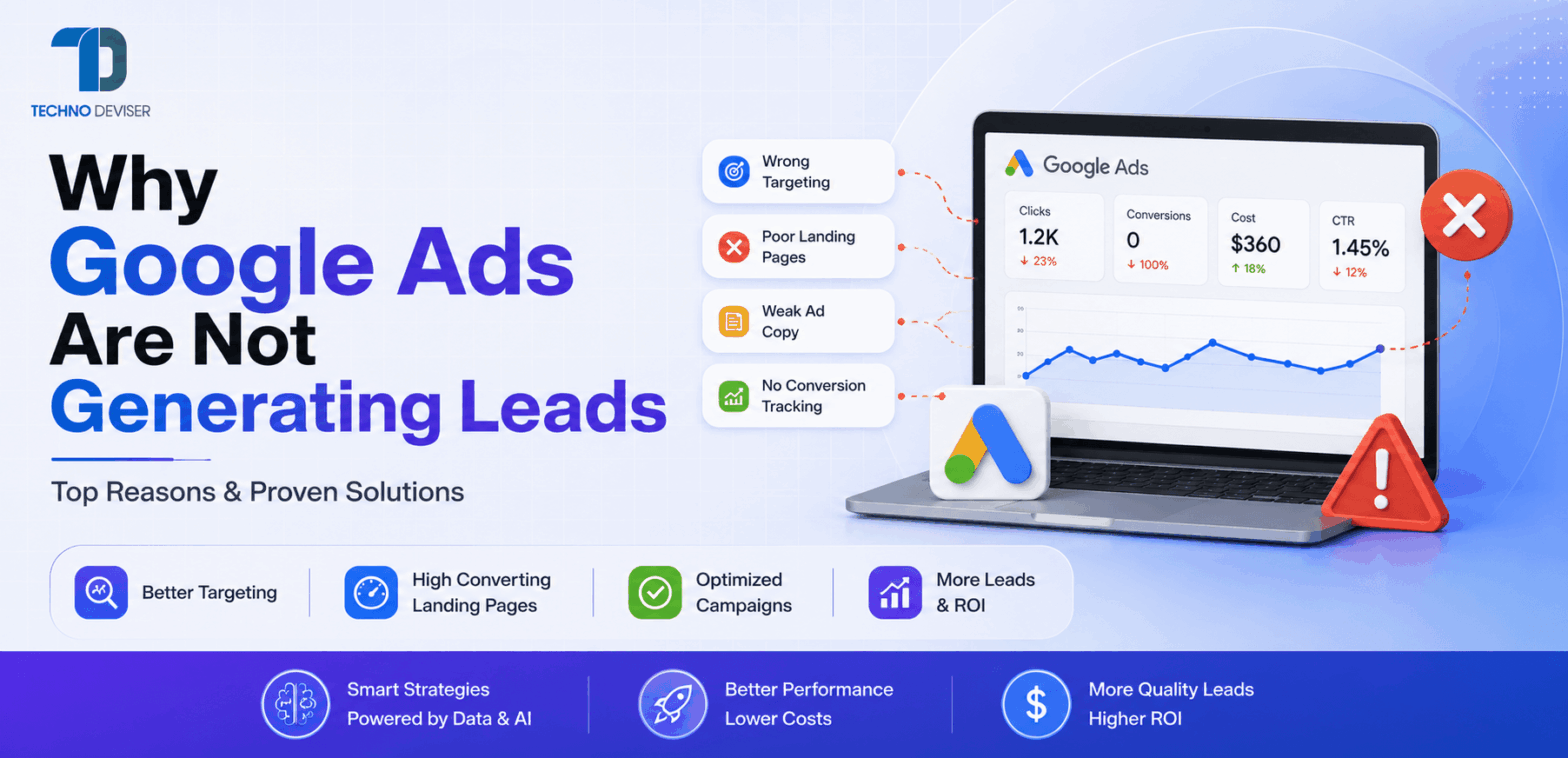
-
 May 11, 2026
-
 Techno Deviser
-
 8 min read
- Introduction
- Why Businesses Struggle With Google Ads Leads
- Wrong Keyword Targeting
- Poor Landing Page Experience
- Weak Ad Copy and Messaging
- Incorrect Audience Targeting
- Low Search Intent Keywords
- Not Using Conversion Tracking Properly
- Poor Mobile Experience
- Budget and Bidding Issues
- Lack of Trust Signals
- Ignoring Negative Keywords
- Running Ads Without Strategy
- Competition and Rising CPCs
- Low Quality Score Problems
- Comparison Table: Poor Google Ads Setup vs Optimized Lead Generation Setup
- Mini Case Study
- Practical Google Ads Optimization Checklist
- FAQs
Introduction
Google Ads can generate high-quality leads quickly when campaigns are planned properly. However, many businesses spend money on ads without getting calls, inquiries, form submissions, or sales.
As competition increases in 2026, running ads alone is no longer enough. Businesses now need strong targeting, conversion-focused landing pages, accurate tracking, fast-loading websites, compelling ad copy, and proper campaign optimization.
Moreover, Google Ads works best when every part of the customer journey is connected. A user clicks the ad, visits the landing page, builds trust, and then takes action. If any step fails, lead generation suffers.
Therefore, businesses should not only ask:
“Why are clicks low?”
They should also ask:
- Are we targeting the right audience?
- Does the landing page build trust?
- Is conversion tracking working correctly?
- Are users finding what they expected?
- Is the campaign optimized for intent?
Understanding these issues can help businesses improve ROI and generate better-quality leads consistently.
Why Businesses Struggle With Google Ads Leads
Many businesses believe Google Ads automatically generates leads after launching campaigns. However, PPC advertising requires continuous optimization.
A campaign may get clicks but still fail to convert because:
- The audience is wrong
- The landing page is weak
- Keywords are too broad
- Ads lack relevance
- Conversion tracking is broken
- Competitors offer better experiences
Additionally, businesses often focus only on traffic instead of conversion quality.
Google Ads success depends on:
- User intent
- Ad relevance
- Landing page quality
- Offer clarity
- Speed
- Trust
- Continuous optimization
Therefore, businesses should treat Google Ads as a complete lead generation system rather than only an advertising platform.
Wrong Keyword Targeting
One of the biggest reasons Google Ads fail is poor keyword targeting.
Many advertisers target broad keywords that attract irrelevant traffic. As a result, they receive clicks from users who are not ready to convert.
For example:
A company offering premium SEO services may target:
- “SEO”
- “marketing”
- “website traffic”
These keywords are too broad and may attract informational searches instead of buying intent.
Instead, businesses should focus on high-intent keywords such as:
- SEO company for small business
- local SEO services near me
- Google Ads management agency
- PPC services for e-commerce
How to improve keyword targeting
Businesses should:
- Focus on buyer intent
- Use phrase and exact match keywords
- Analyze search terms regularly
- Group keywords properly
- Separate informational and transactional intent
Moreover, long-tail keywords often generate better leads because they reflect clearer intent.
Poor Landing Page Experience
Even good ads can fail if the landing page performs poorly.
A user may click an ad expecting a solution, but if the page is slow, confusing, or untrustworthy, they leave immediately.
Landing pages should:
- Match the ad message
- Load quickly
- Explain benefits clearly
- Include strong CTAs
- Build trust
- Work perfectly on mobile
Common landing page mistakes
Businesses often lose leads because:
- The page loads slowly
- Forms are too long
- Headlines are unclear
- There are too many distractions
- The design looks outdated
- Contact information is hidden
Additionally, some businesses send ad traffic to the homepage instead of a focused landing page.
This usually reduces conversion rates.
Weak Ad Copy and Messaging
Ad copy strongly affects click quality and conversion intent.
If ads are vague, generic, or misleading, users may click but not convert.
Good ad copy should:
- Solve a problem
- Highlight benefits
- Include keywords naturally
- Create urgency
- Build trust
- Explain why the business is different
Examples of stronger messaging
Weak ad:
“Best Digital Marketing Services”
Better ad:
“Generate More Leads With ROI-Focused Google Ads Management”
Specific messaging usually attracts higher-quality clicks.
Incorrect Audience Targeting
Sometimes campaigns target the wrong audience completely.
For example:
- Wrong locations
- Wrong age groups
- Wrong devices
- Wrong audience interests
- Irrelevant remarketing users
As a result, ad spend gets wasted.
Businesses should regularly review:
- Geographic performance
- Device performance
- Audience segments
- Demographics
- Time-based performance
Additionally, remarketing campaigns should target users differently based on behavior.
Low Search Intent Keywords
Not every keyword leads to conversions.
Some searches are informational rather than transactional.
For example:
- “What is SEO”
- “Google Ads tutorial”
- “How PPC works”
These users may not be ready to buy services.
Therefore, businesses should separate:
- Learning intent
- Research intent
- Buying intent
High-converting campaigns usually focus more on transactional searches.
Not Using Conversion Tracking Properly
Many businesses cannot identify why campaigns fail because conversion tracking is incomplete or broken.
Without proper tracking:
- Leads cannot be measured accurately
- Optimization becomes difficult
- Smart bidding may fail
- Budget allocation becomes inaccurate
Important tracking setups
Businesses should track:
- Form submissions
- Calls
- WhatsApp clicks
- Purchases
- Appointment bookings
- Lead quality
Additionally, Google Tag Manager and GA4 should be configured properly.
Poor Mobile Experience
Most Google Ads traffic now comes from mobile devices.
Therefore, a poor mobile experience can destroy lead generation performance.
Mobile landing pages should:
- Load fast
- Have clickable buttons
- Use short forms
- Display contact details clearly
- Avoid clutter
If users struggle to navigate the page, they leave quickly.
Budget and Bidding Issues
Some campaigns fail because budgets are too low for competitive industries.
In industries like:
- Legal services
- Education
- Real estate
- Digital marketing
- Finance
Cost-per-clicks can be very high.
As a result:
- Ads may not get enough visibility
- Data collection becomes slow
- Optimization becomes difficult
Businesses should:
- Start with realistic budgets
- Focus on high-intent campaigns
- Avoid spreading budgets too thin
Lack of Trust Signals
Users rarely submit forms on websites they do not trust.
Therefore, landing pages should include:
- Testimonials
- Reviews
- Certifications
- Client logos
- Case studies
- Clear contact details
- Security signals
Trust-building elements improve conversion rates significantly.
Ignoring Negative Keywords
Negative keywords prevent ads from showing for irrelevant searches.
Without them, businesses waste money on poor-quality clicks.
Examples:
A premium agency may exclude:
- free
- cheap
- jobs
- internship
- course
Regular search term analysis is extremely important.
Running Ads Without Strategy
Some businesses launch campaigns without:
- Funnel planning
- Competitor analysis
- Audience research
- Landing page testing
- Clear goals
As a result, campaigns become inconsistent.
Google Ads requires:
- Testing
- Optimization
- Data analysis
- Continuous improvement
Successful advertisers constantly refine campaigns.
Competition and Rising CPCs
Google Ads competition continues increasing in 2026.
Many industries now experience:
- Higher CPCs
- Aggressive bidding
- More advertisers
- Better competitor landing pages
Therefore, businesses must compete through:
- Better user experience
- Stronger offers
- Better targeting
- Higher-quality content
- Faster landing pages
Low Quality Score Problems
Quality Score affects:
- Ad rankings
- CPCs
- Visibility
Low Quality Scores usually happen because:
- Keywords lack relevance
- Landing pages are weak
- Ads are generic
- User experience is poor
Improving relevance across campaigns often reduces advertising costs.
Comparison Table: Poor Google Ads Setup vs Optimized Lead Generation Setup
| Area | Poor Setup | Optimized Setup |
| Keywords | Broad targeting | High-intent keywords |
| Landing Page | Generic homepage | Dedicated conversion page |
| Ad Copy | Generic messaging | Benefit-focused messaging |
| Tracking | Missing conversions | Complete tracking setup |
| Mobile Experience | Slow and cluttered | Mobile-first optimized |
| Trust Signals | Few credibility elements | Reviews, testimonials, proof |
| Negative Keywords | Ignored | Regularly updated |
| Strategy | Random campaigns | Funnel-based planning |
| Optimization | Rare updates | Continuous improvement |
| Audience Targeting | Broad audiences | Intent-based targeting |
Mini Case Study
A local service company launched Google Ads but received very few inquiries despite getting clicks.
After reviewing the account, several issues appeared:
- Broad keywords
- No negative keywords
- Slow landing page
- Weak CTA
- No call tracking
- Mobile usability problems
First, the campaign structure was reorganized around high-intent keywords. Then, dedicated landing pages were created for each service.
Next, mobile optimization improved speed and form usability. Negative keywords were added, and call tracking was configured correctly.
Within a few weeks:
- Conversion rate improved
- Cost per lead decreased
- Lead quality improved
- Call inquiries increased
This shows that Google Ads performance depends on the full conversion system, not only ad spend.
Practical Google Ads Optimization Checklist
Campaign Checklist
- Use high-intent keywords
- Add negative keywords
- Create separate ad groups
- Write stronger ad copy
- Use ad extensions
- Track conversions properly
- Optimize for mobile users
- Improve Quality Score
- Test multiple headlines
- Review search terms weekly
Landing Page Checklist
- Fast loading speed
- Clear headline
- Strong CTA
- Trust signals
- Mobile-friendly design
- Short lead forms
- Relevant messaging
- Simple navigation
- Contact details visible
- Conversion tracking installed
Expert Insight
“Google Ads does not fail only because of bidding or keywords. In most cases, lead generation problems happen because businesses ignore the complete user journey. Successful campaigns combine targeting, trust, speed, messaging, landing page optimization, and conversion tracking together.”
FAQs
Why are my Google Ads getting clicks but no leads?
This usually happens because of poor landing pages, weak targeting, low buyer intent, missing trust signals, or incorrect tracking setup.
How long does Google Ads take to generate leads?
Some campaigns generate leads within days, while others need several weeks of optimization depending on competition, budget, targeting, and industry.
Can a bad website affect Google Ads performance?
Yes. A slow, confusing, or outdated website can reduce conversions even if ads generate quality traffic.
Why is conversion tracking important in Google Ads?
Conversion tracking helps businesses measure leads, optimize campaigns, improve bidding strategies, and understand ROI accurately.
Table of Content
- Introduction
- Why Businesses Struggle With Google Ads Leads
- Wrong Keyword Targeting
- Poor Landing Page Experience
- Weak Ad Copy and Messaging
- Incorrect Audience Targeting
- Low Search Intent Keywords
- Not Using Conversion Tracking Properly
- Poor Mobile Experience
- Budget and Bidding Issues
- Lack of Trust Signals
- Ignoring Negative Keywords
- Running Ads Without Strategy
- Competition and Rising CPCs
- Low Quality Score Problems
- Comparison Table: Poor Google Ads Setup vs Optimized Lead Generation Setup
- Mini Case Study
- Practical Google Ads Optimization Checklist
- FAQs
Leave a comment
Your email address will not be published. Required fields are marked *